

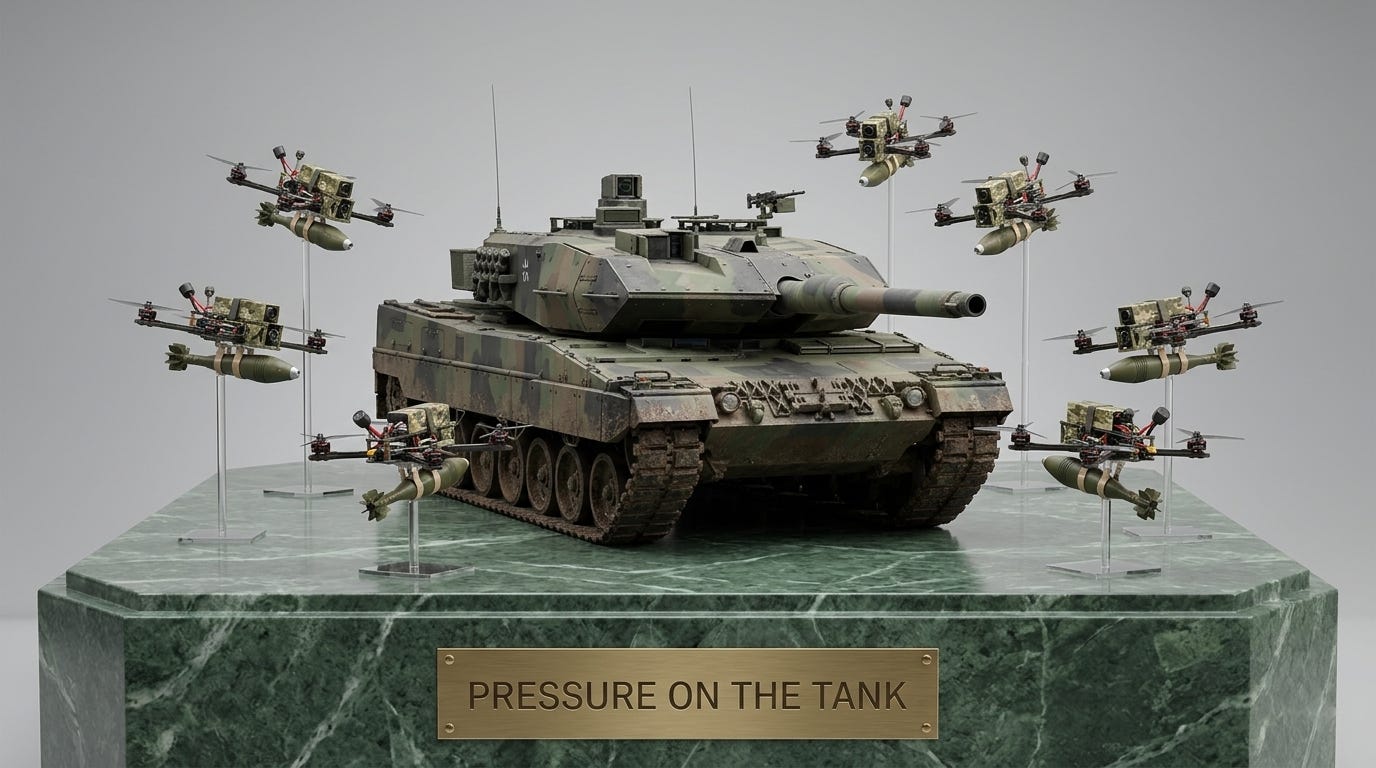
Pressure on the Tank?
Can the tank’s relevance be saved amid drone warfare, and can the tank keep up with drone innovation cycles? An important update.

“Where people have started to predict the death of the tank, I think they’re misunderstanding what probably will happen.”
— Daniel Driscoll, US Secretary of the Army
“We’re screwed.”
— anonymous commanding officer during NATO Hedgehog 2025
In the spring of 2025, on the ranges of Estonia, NATO ran Hedgehog, the largest exercise the country stages, around 16.000 troops from twelve nations rehearsing the defense of the eastern flank, the scenario the Baltic states actually lose sleep over. A NATO maneuver force, a British brigade with Estonian elements, played the attack. The mechanized forces moved according to time-honored doctrine. Tents went up, vehicles parked, the armored formation did what a formation does.
On the other side of the exercise sat a small group of Ukrainian drone operators, brought in as Team Red; men who’d spent the last three years doing this for real over the Donbas. They didn’t have to break the armor with maneuver. They watched it through the eyes of an FPV camera feed, fed the picture into Ukraine’s Delta battle-management system (BMS), and went to work. By the account that reached the Wall Street Journal months later, a team of roughly ten operators caused simulated umpire-confirmed losses of seventeen armored vehicles in about half a day, and a larger element destroyed two battalions in a day. One NATO commander summed it up, as confirmed by multiple sources, with three words: “We’re screwed.”
Close your eyes and imagine the picture: A modern NATO maneuver force, on its own ground, handed to a handful of men with cheap UAVs. The armies on the receiving end reacted the way soldiers do: they went looking for wire.
What You Will Learn in this Deep Dive
Why the main battle tank, in the shape we were all taught, has receded from two of the last big wars, and what the loss numbers actually say.
The real cost-exchange between a drone and a tank, which isn’t the one you’ve been sold.
Whether the survivability stack (cages, active protection, counter-drone vehicles, jammers, signature camo, lasers…) can innovate the tank out of the corner.
The one question that decides everything: as drones improve, can the tank keep up?
Whether there’s a there there for unmanned, tank-sized objects on the battlefield.
What the tank was for, going back to the Maginot Line, which of those jobs are being stripped out from under it, and why.
Where this leaves breach, assault, and the holding of ground, and what I’d recommend MoDs, investors, and industry to do about it.
Where the Tank Comes From
Before we take it apart, let’s be clear about what the tank has been. Tanks have, for almost a century, been incredibly and uniquely useful, and it would be foolish to brush that off.
The tank was the answer to a specific problem. The trench, barb wire and the machine gun had frozen the front, and only small formations (not unlike current motorcycle and dismounted formations) could cross the ground. At Cambrai in November 1917, and decisively at Amiens in August 1918, massed armor with infantry and artillery restored movement to a war that had next to none. The interwar theorists, Fuller, Guderian, Tukhachevsky, and de Gaulle, built doctrine on top of that, and the thing we call Blitzkrieg followed. Here’s the part most people overlook, though: Blitzkrieg was never about tanks alone. The Panzer division was armor, motorized infantry, artillery, and aircraft working as one. The tank’s power was always systemic. Like a modern aircraft carrier, which would be too vulnerable without its strike group, the tank was an embedded means of warfare. Hold that thought; it comes back at the end of this piece.
By the Cold War, the main battle tank had become the decisive doctrinal instrument for the European plain. Under AirLand Battle doctrine, armor existed to do three things in the offense: Breach the obstacle, assault to close with and destroy, and help hold the ground that was taken. Conceptually, the tank was the maneuver answer to the Maginot doctrine of fixed fortification, the thing that goes through, or around, the wall.
And there’s a serious camp of highly experienced folks, many of whom I avidly read and follow, that says that all of this remains true today. What else, they ask, provides protected, mobile, direct, serious firepower for the assault? You can’t take ground with a drone. Their argument deserves a fair shake, and we’ll give it one. But first, we need to talk numbers.
What the Loss Numbers Actually Say
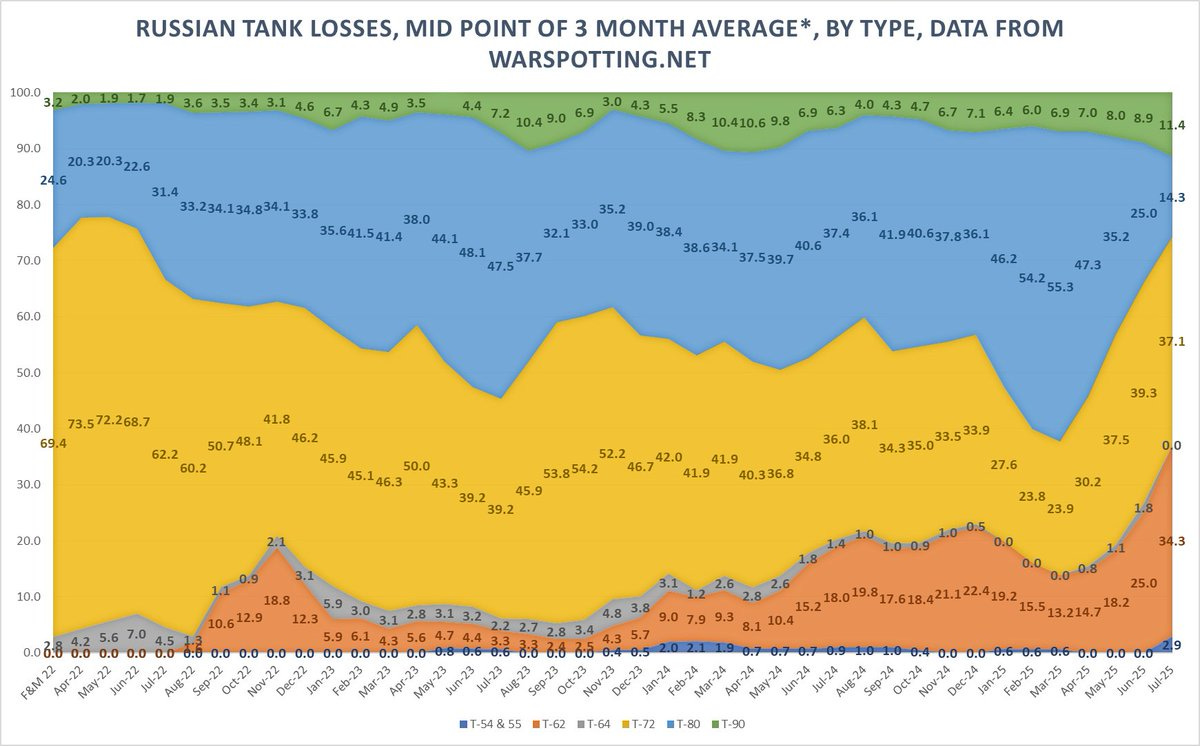
According to open-source tracking compiled from Russian Ministry of Defense data, Russia lost roughly 116 tanks in June 2024. In June 2025, the figure was about 22, in July, the number collapsed from 97 down to 19 year over year. What does a collapse like that mean? Not that the tanks were taken out faster. They were being used less, because using them had become su1cdal.
Analyst David Axe, working from DeepState and Oryx figures, puts Russian vehicle losses at roughly 26 per day in 2022 and fewer than 8 per day by late 2025, the lowest sustained rate in 46 months of war. A disturbing fact often gets ignored when lookig at these numbers: Over the same time-stretch, Russia took more ground in 2025 than in 2024. The armor receded, and the line still moved; seemingly even better than with tanks. It moved on foot, on motorcycles, on quad bikes, and, on more than one documented occasion, on horseback.

Why did the tank pull back? Because somebody changed the calculation. The headline you’ve seen is that small drones now account for around 65 percent of Russian tank losses, a figure that traces back to a NATO assessment and various Ukrainian sources, and we should treat it as a range of roughly 60 to 75 percent rather than a hard number (there is no such thing as a precise count or measurement in a war). The more careful version comes from the French institute IFRI, whose analyst Léo Péria-Peigné, working from front-line interviews, put the drone share nearer 50 percent in 2025, and added the caveat that matters more than the percentage: a large portion of tanks logged as drone kills had in fact been immobilized first by mines, by artillery, or by their own breakdowns, and were then finished by an FPV. More nuance applies when looking into vehicle losses vs. mission kills (disabling the tank instead of destroying it). Tank-on-tank kills, the thing the whole platform is optimized around, are now something like 5 percent of losses. In 2026, it seems, it’s tanks looking for tanks.
What about the cost-exchange ratio I have been writing about in this publication ad nauseam? A bit of nuance is in order: Yes, an FPV costs around 500 USD and a T-90M is a roughly 3 to 4,5 million USD vehicle. But the kill ratio isn’t 1:1. By the first-hand sortie log that Michael Jajcay published in War on the Rocks, roughly 43 percent of FPV missions hit the intended target, about a third are downed by enemy electronic warfare before arrival, and a quarter never take off at all. Even of the strikes that are successful, by the Polish center OSW’s reckoning, 60 to 80 percent fail to destroy the target outright. Put it together, and in a contested, electronically contested environments, it takes on the order of three to ten-plus drones to put one tank out of action. This should serve as a stark reminder not to be influenced by “successful strike video bias” (the fact that troopy will rather show successes than failures and that this warps the image the public has of the actual effectiveness of weapons systems and tactics).
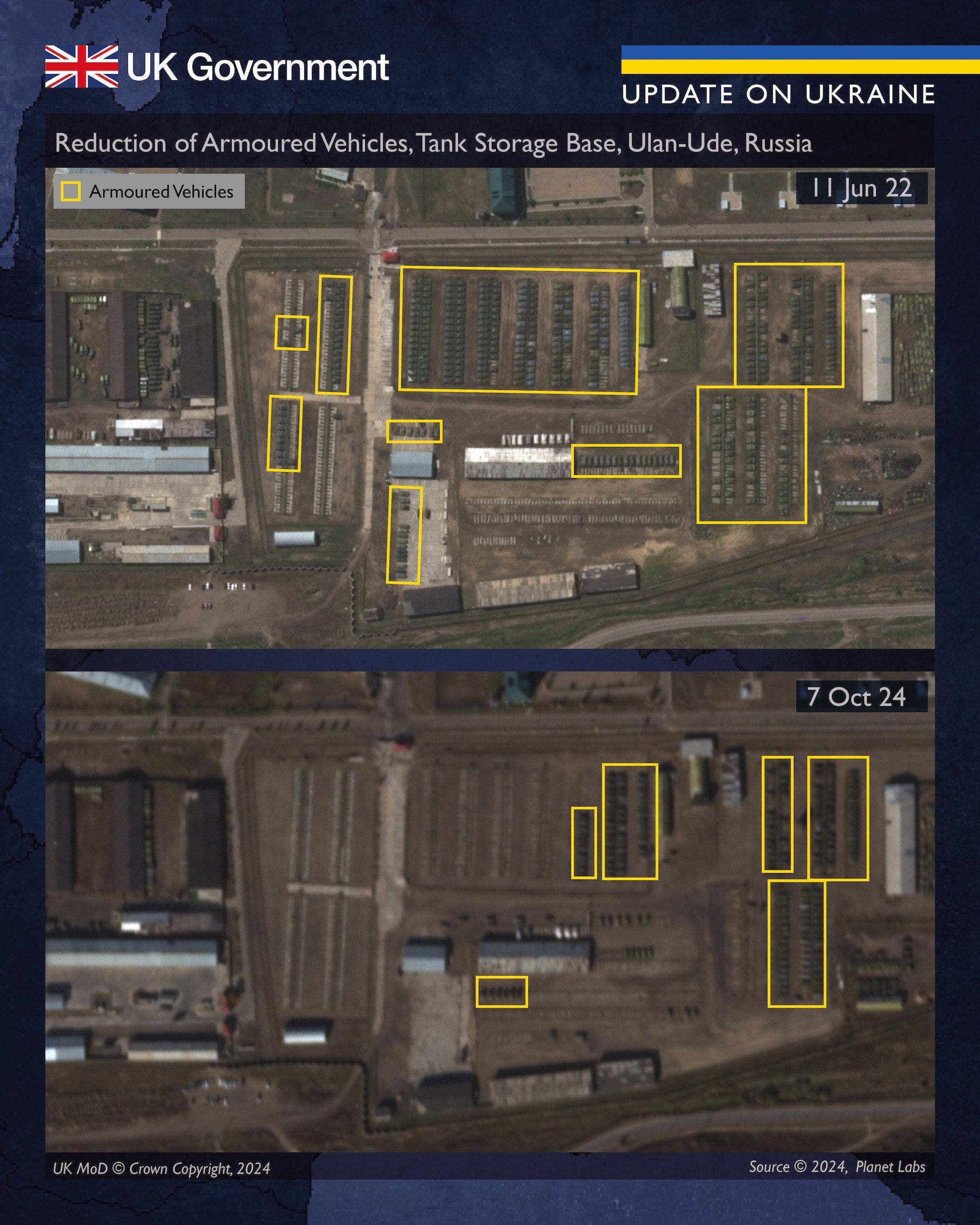
Russian military equipment storage base Ulan-Ude.
That’s still a massacre in terms of cost-exchange ratio. Three to ten drones is somewhere around 1.500 to 5.000 USD against a multimillion-dollar vehicle. But still: the drone’s end of the cost-exchange ratio is thousands to tens of thousands of dollars per kill instead of five hundred. The core fact that remains is that, as long as one side can build cheap UAVs (and price is of the essence, as my regular readers know) by the million and the other can’t, mechanized maneuver anywhere within the 20-km killzone will stay a losing game. Ukraine, by figures its own National Security and Defense Council has published, was producing FPVs at a rate approaching 200.000 a month in 2026. The West builds new tanks at a rate of roughly 200 a year, total. It stands as a fact of nature that drones can be replenished faster than main battle tanks (MBTs), and this is crucial.
There’s a second factor, and it’s the one I am currently paying most attention to: The autonomy gap for FPV strike UAVs (quadcopters and mid-strike fixed-wing FPV drones like the Hornet) is closing. Ukrainian terminal-guidance modules like The Fourth Law’s TFL-1 and Auterion’s Skynode S now fly the last several hundred meters with no radio link at all. The vendors claim hit rates of 80 to 90 percent (vendor numbers, so treat them with the usual caution). As of mid-2025, Ukraine’s own Brave1, through its artificial-intelligence lead Makarchuk, put the real human-piloted baseline at 30 to 50 percent, as low as 10 for a novice, with autonomy a path toward the higher number rather than an arrival at it. That figure is a year old now, which, in this war, is a long time, and the gap has been closing since. The fiber-optic FPV UAV, which now makes up roughly a quarter to a third of strikes front-wide, is the second answer to the same electronic-warfare problem. Neither is finished, but both are pointed at the tank.
If you want the extreme case of where this leads, take a look at the twelve-day Iran-Israel war of June 2025. Two states roughly 2.000 kilometers apart, no shared border, around 550 ballistic missiles and 1.000 drones flung one way, interceptors and strike aircraft the other, and essentially zero ground maneuver. The main battle tank, of which both sides own plenty, had no part to play. As has become obvious in the War on Iran, in 2026, no commander is exactly excited about a ground campaign. As I will argue in the rest of this article, this is majorly due to drone warfare.
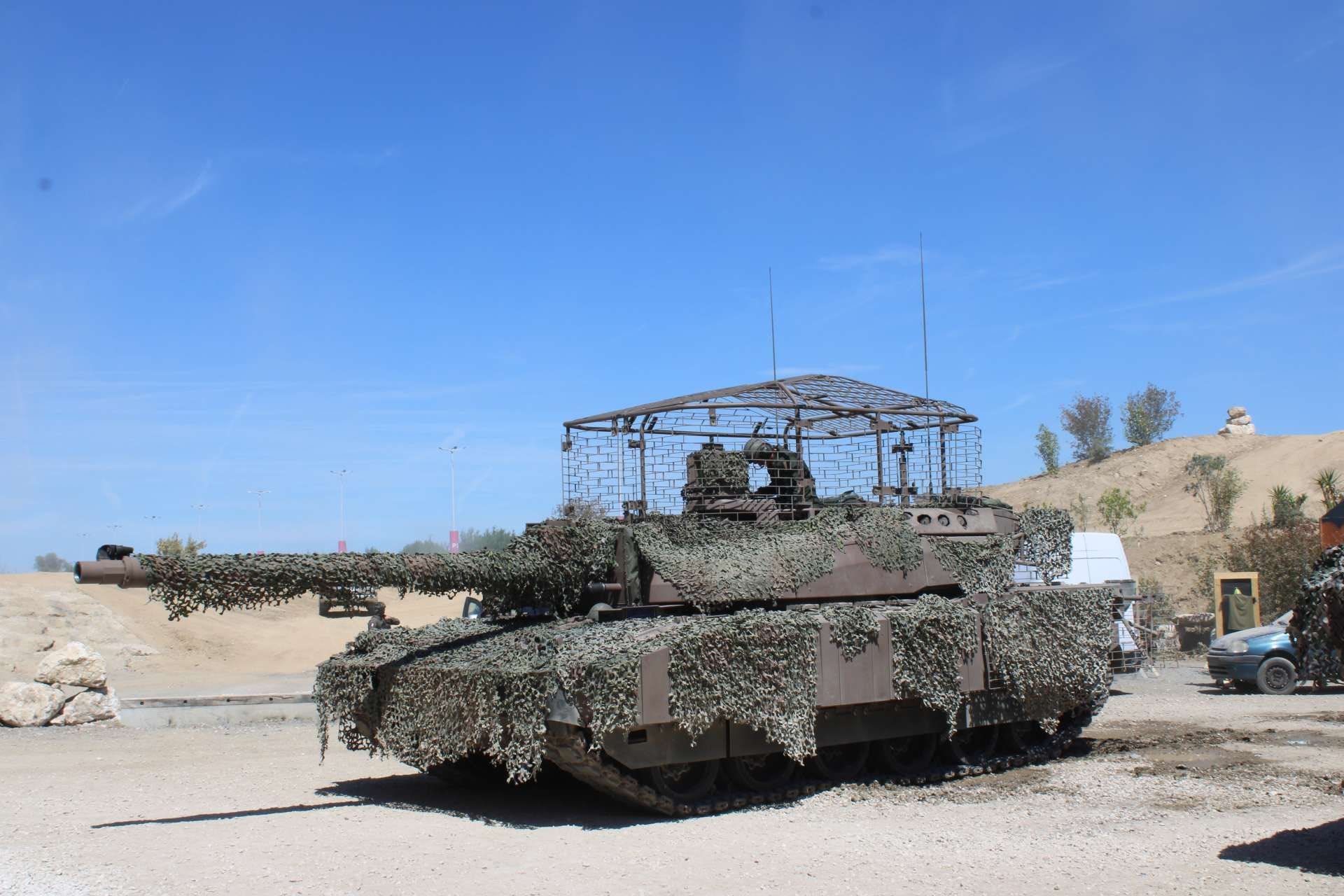
Don’t call it a cope cage: the Leclerc’s new dress.
Can the Tank Be Innovated Out of the Corner?
The thing to understand up-front is that none of the survivability layers created for the tank against drones is a real shield. Each one simply lowers the probability that a given drone kills you, and each one has limits which are already being exploited or exploitable.
Let’s start with cages. The French Army rolled its Leclerc XLR onto the dynamic display at Eurosatory the other week, wearing the very cope cage that French doctrine mocked until recently (and a tiny one at that). It’s a factory item now, built by KNDS, covering roof, engine deck, and rear. The Germans are further behind than that. When their crews fitted cages at the Freedom Shield exercise in Lithuania in May 2026, the work was improvised, roof-only on the Leopards, with the larger wrap-around mounted onto a Fuchs carrier rather than the tank. Is this because the institutional German bet is on a different means of protection? The Trophy active protection system fitted to the new Leopard 2A8 mandates discussion (see next paragraph). The Ukrainian verdict about the German nets and cages, as reported by milbloggers, was blunt: A few drones will get any vehicle, and it wasn’t even clear if the mesh was metal. Does a cope cage buy you something? It does. A Ukrainian Leopard 1A5 reportedly took 52 FPV and Molniya hits behind cage, reactive armor, and spikes, and managed to make it out. What a cage doesn’t buy you is immunity, because there is something called double-tap: One drone opens the cage, the second drives a shaped charge through the hole.
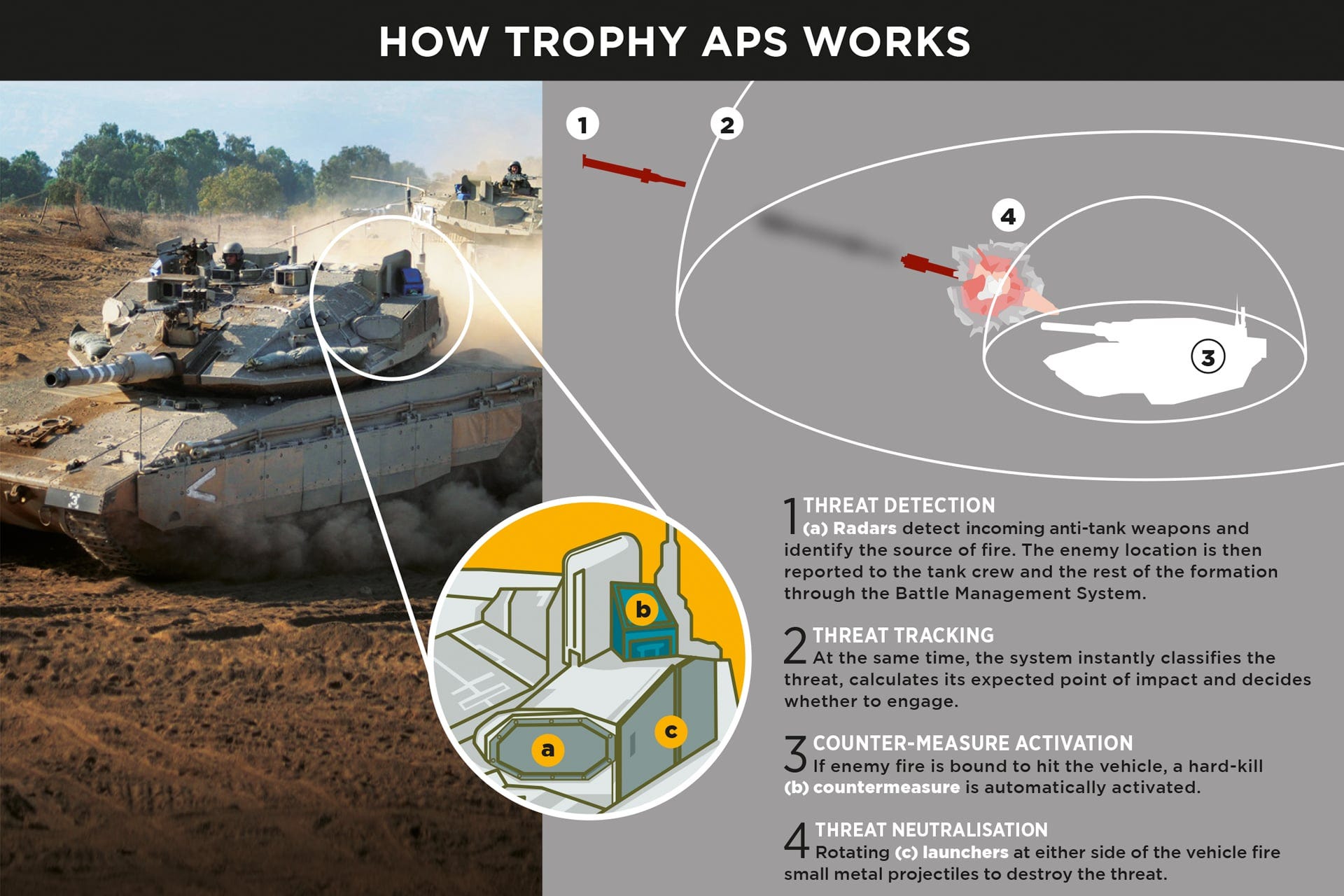
Let’s talk about active protection. Trophy, Iron Fist, the Russian Arena-M, Rheinmetall’s StrikeShield: These are genuinely good systems, combat-proven against the threat they were built for, a fast, hot anti-tank missile or rocket, whether horizontal or top-attack. The FPV is the opposite of that threat in every regard: It’s slow, it’s cool, it dives from above at 50 to 85 degrees, it drops bombs, it maneuvers, and it comes in numbers. Trophy’s launchers can elevate to roughly 55 degrees, which leaves, as analysts have put it, a doughnut of vulnerability directly overhead. The Russian Arena-M is, as stated by its own designers, blind above 20 degrees, and the chief of the relevant Russian institute admitted in November 2025 that “the necessary algorithmic solutions have not yet been created” for the drone problem, whatever that means (I’ll take it as “numbers game, bad”). There’s a second limit that matters just as much: Each of these systems carries only a handful of shots before it has to reload. Trophy fires perhaps six engagements, Iron Fist holds around four ready interceptors, Arena-M a dozen or so tubes, firing two shots at a time. as is the case with other offensive action since the advent of drones (think deep precision strike, for example), a salvo larger than the magazine gets through on numbers alone. As is often the case in recent years, the US defense budget is the Western coal-mine canary: The US Army, by The War Zone’s reporting, put 92 of 108 million dollars of its vehicle-survivability request into passive cope cages rather than into interceptors, while admitting the cages may interfere with the active protection they sit on top of. Where do we go from here?
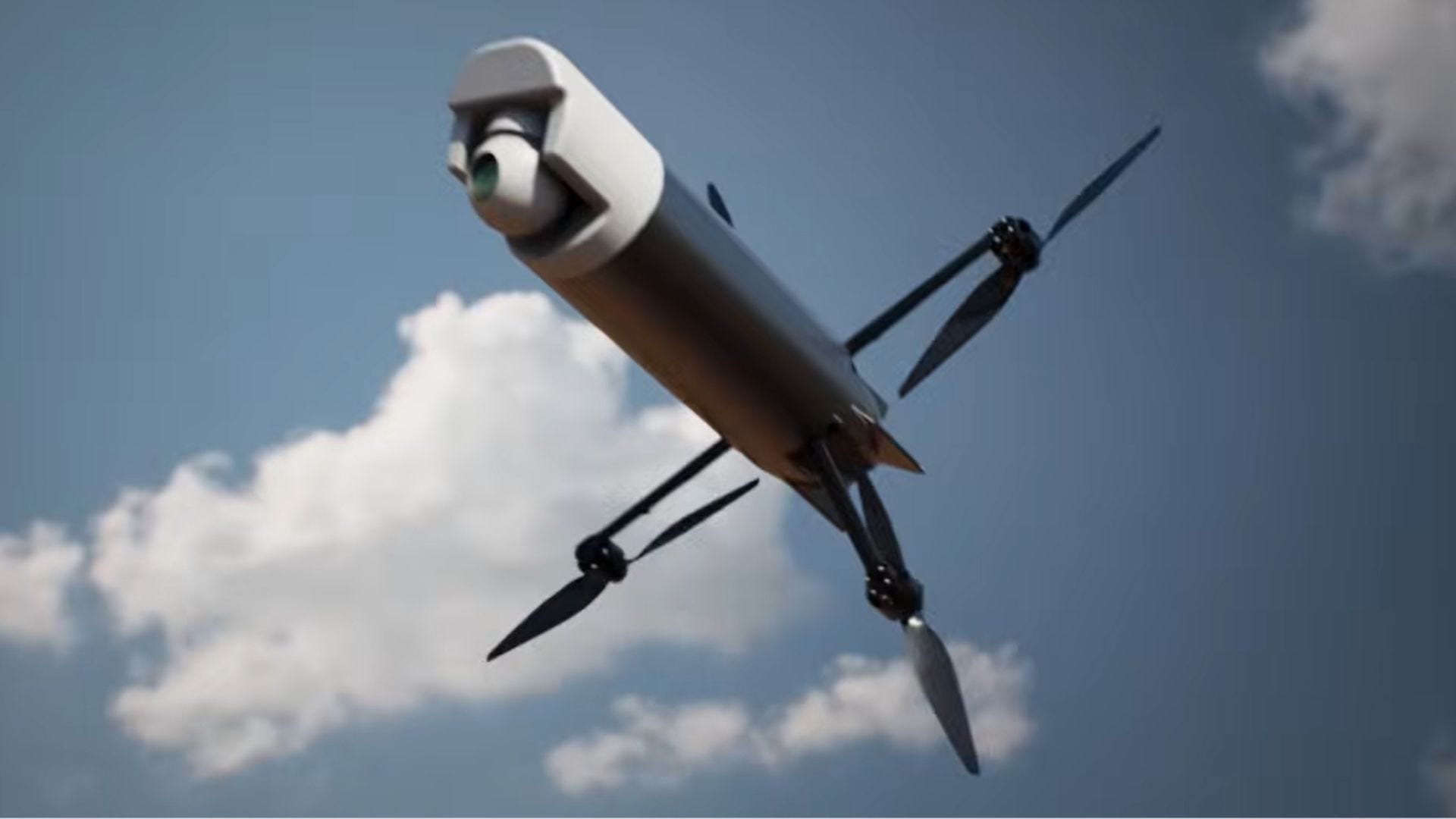
The Iron Wasp by Rafael is meant to serve as a tube-launched ISR, strike, and interceptor drone for armored vehicles.
Can Interceptor drones save the tank? At Eurosatory this June, three of them broke cover within four days. Rafael and SpearUAV showed Iron Wasp, a canister-launched interceptor drone on an armored vehicle. Spain’s EM&E showed the ODIN 6x6, which fields two optically-guided interceptor drones alongside a 30mm gun, four radars, and electronic-warfare gear. South Korea’s Hanwha showed a launcher of its own. The concept is sound: Give the maneuver unit a cheap, magazine-deep way to defeat the cheap thing that’s defeating it. But as of June 2026 these are product launches and prototypes, which have taken a long time to develop, with few confirmed orders and next to no combat-kill data from a moving vehicle, especially not from Ukraine. A more mature alternative is the gun, for instance Rheinmetall’s Skyranger with its 35mm airburst rounds, and I’ll come back to where that one’s going a bit later, because it’s a bit counterintuitive.
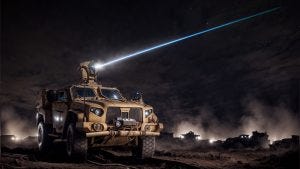
Lite Beam by Rafael.
What about Lasers? They’re early, but already being pushed into stationary installations and swimming power stations (cruisers and frigates). There are interesting developments for armed vehicles, like the 10-kw Lite Beam by Rafael, and it’s becoming more and more evident that lasers are going to be a fixed part of any battlefield operation, likely across domains, and across mechanized capability class. However, they’re no panacea, either (as nothing is), by which I mean that they’re energy-hungry (and thus energy-constrained), without active power generation they require massive batteries (meaning weight, meaning reduced maneuverability/range/terrain options, they are angularly constrained (vulnerable to, for example, a multi-angle, ultra-low-flying FPV strike UAV attack), they generate massive amounts of heat (which means they frequently shut down due to overheating, and they are about as visible as… a laser pointer), they require perfect, continuous and autonomous lock-on-target, which can be hard when dealing with acrobatic/agile UAVs, bombers, and low-flying targets, and they are not only highly visible in dust and damp conditions, but also highly susceptible to degradation because of dust and damp conditions. No panacea.
Underneath all of this, a pink elephant sits, which no passive or active protection system can hide: A tank is a 60-plus-ton object with an engine running at several hundred degrees, throwing dust, sound, and a massive seismic signature, on a battlefield watched continuously by cheap cameras feeding machine-cued targeting. Jammers still defeat the radio-controlled majority of drones, but they’re categorically blind to the fiber-optic ones and to radio-silent drones with autonomous terminal guidance, which will become ubiquitous in 2027. Signature camouflage kit, like the multispectral camouflage from Saab and others, buys distance and delay, but also occasionally backfires when the thermal cloak makes the tank look colder than the surrounding soil, and the cloak becomes the very anomaly the operator (or algorithm) is looking for. The roof of a tank is thin due to physics, on the order of 50 to 100mm against 500 to 800mm at the front, because you can’t put the mass up top without wrecking the mobility, which is why even reactive armor on the roof has to be damped so its own blast doesn’t blow a hole into the thing it protects. The most on-point statement about this topic was made no less than six years ago by RUSI’s Jack Watling and Justin Bronk, whose 2020 paper was titled, before any of this (but not before drones, as Turkey used Bayraktars back then already), “Your Tanks Cannot Hide”. They were right.
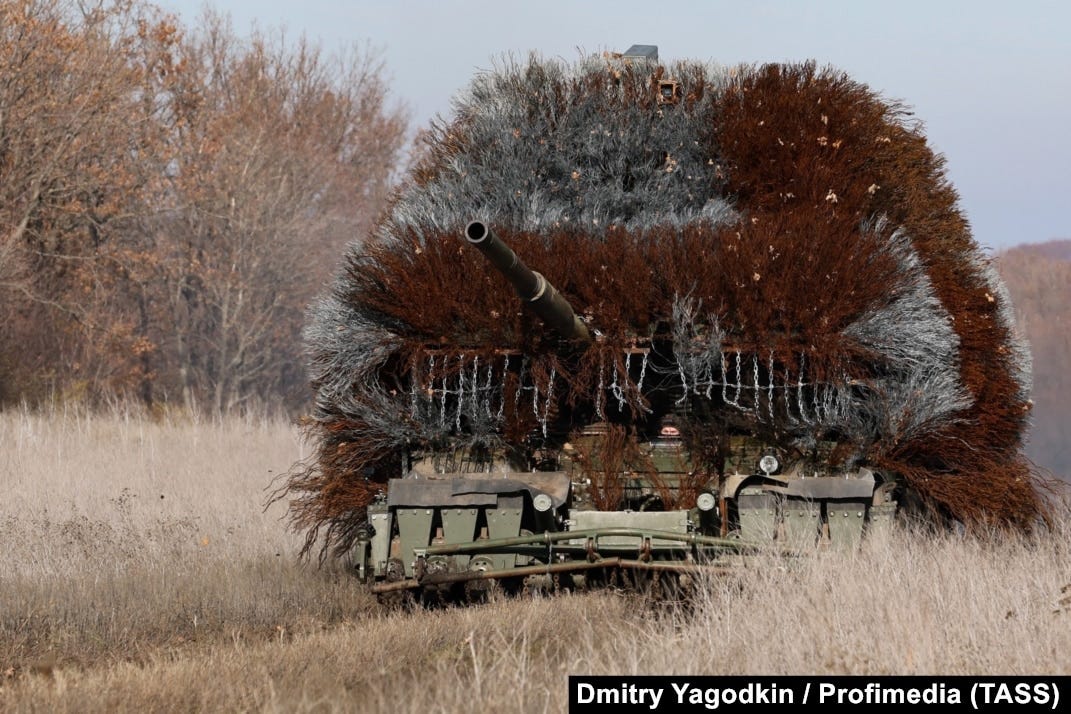
I don’t know about you, but I could look at hedgehog tanks all day. They do have something cute and animal-like, don’t they? Inside it looks a little bit less cute: almost zero visibility, ultra-slow movement, and a barrel locked in place and basically rendered ineffective. Many of then ended up in ditches and trees; I wonder why…
Can the Tank Keep Up?
The rule of thumb goes more or less like this: Every layer of protection requires a specific munition to defeat it, and the munition is always cheaper than the platform. So the real contest isn’t tank versus drone, but protection versus warhead, and the warhead is iterating faster.
Let’s chronicle the development of protective measures: Cope cage in 2022, full turtle-tank shed in 2023, “porcupine” tanks bristling with hundreds of steel spikes in 2024, “hedgehog” tanks welded over with tens of thousands of strands of unraveled cable in 2025, a patented “dandelion” arrangement of flexible rods after that. Each time, a more cost-exchange-efficient countermeasure emerged rapidly. Against the cage and reactive armor, the tandem warhead and the double-tap. Against standoff cover, Russia’s factory-made Kaplya explosively-formed penetrator, unveiled in February, which a Ukrainian analyst estimated could exceed 100mm of penetration, with the dry note that “this is not garage engineering, this is industrial-scale adaptation.”
And then, on June 12th, David Hambling reported the news that made the Russian milbloggers nervous: A Ukrainian drone bomb shaped like a fence post. The mechanism isn’t exotic chemistry, just a delayed fuse on a penetrating body that punches through the netting, the cages, and the overhead cover that two years of counter-drone effort have relied on, and then detonates underground or inside, “enough to collapse one side of a building.” The whole investment in driving men and vehicles under wire and into cover, devalued by a piece of bent steel on a 1.000-USD airframe. The bombers carrying these are getting better in parallel, the heavy Vampire-class multicopters going from roughly 20 to 60 kilometers of reach and from around 20.000 to 8.500 USD a unit as economies of scale take hold. The single limit still standing on the strike side is precision against the weak point: Terminal guidance, by Ukrainian accounts, still can’t reliably steer for the roof or the engine deck. How long does that gap last? On current evidence, not long.
So, can the tank keep up? On the engineering, sometimes, for a while. On the calculation, no. The protection has to be bought once per vehicle, at tonnes and high cost. The countermeasure can be invented and immediately printed. In this COTS arms race we’re in, every advantage one side fields is a matter of weeks to months from belonging to both. The US Army’s own 92-million-dollar cope-cage procurement, by The War Zone’s reporting still not finalized in design and of unknown effectiveness, is the institutional version of the same admission. Have we reached a new level of helplessness when it comes to traditional armor?
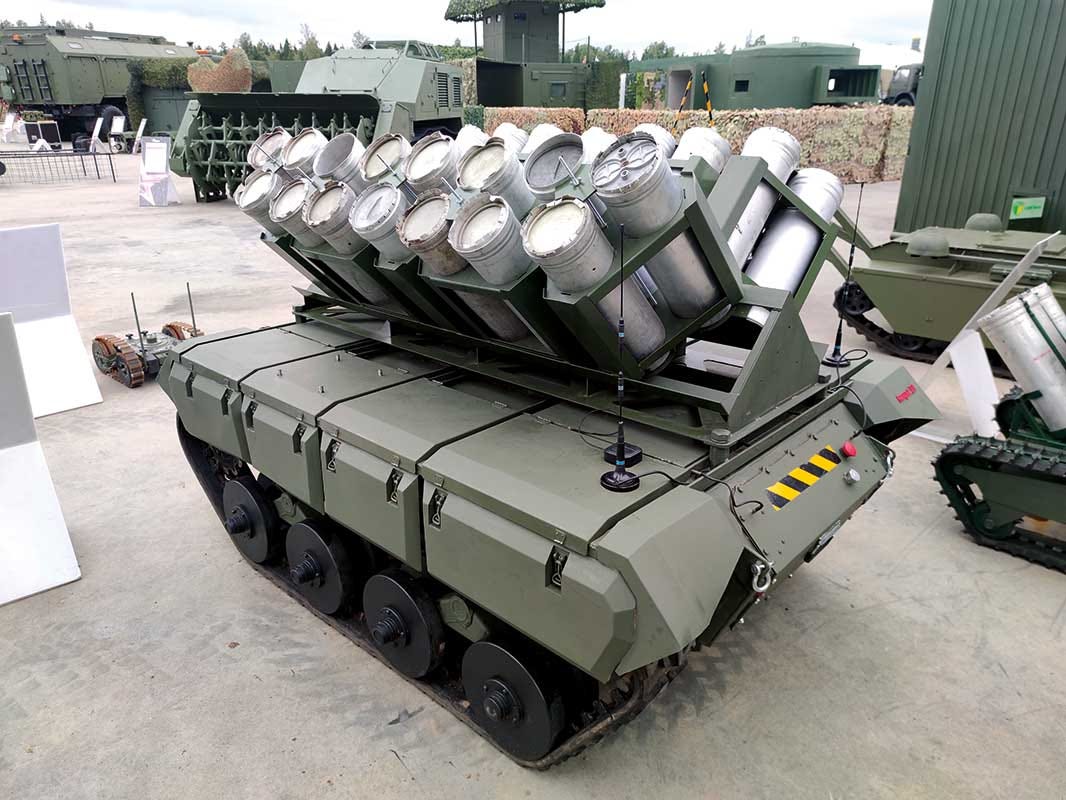
Impuls-KPTM: Mine-laying is only one of the many jobs taken over by UGVs near the frontline in Ukraine.
The New Spiritual Home
If you can’t protect the platform, atomize it: Armies, before all (surprise, surprise) the Ukrainian one, have started taking the MBT platform apart and handing its jobs to things that are cheaper to lose. The tank’s mission set is being atomized, stripped out one function at a time, and the proof is in the pudding on the frontline.
Breaching, the job of the engineering tank under fire, is going to the unmanned ground vehicle. Milrem’s THeMIS with a line-charge module clears a lane of roughly 54 meters; Ukraine’s Zmiy, at around 20.000 USD, clears thousands of square meters of mines a day at the pace of an assault. Direct fire and overwatch are going to gun-armed UGVs, to loitering munitions for the top-attack shot, and to the FPV. Persistent overwatch is a quadcopter or a fixed-wing ISR drone. Shock, the thing massed armor was for, is being replaced by saturation, what former Ukrainian defense minister Andriy Zagorodnyuk calls precision applied at scale. Even holding a position has a machine version now, and we’ll get to how far that goes.
An important first was achieved in April. On Arms Makers’ Day, President Zelensky stated that Ukrainian forces had, for the first time in the war, taken a defended enemy position “exclusively by unmanned platforms,” with the defenders surrendering and no Ukrainian infantry crossing the line of departure. Treat it as the Ukrainian command claim it is, on a symbolic day, and an ex-SBU skeptic was right to call it probably a small position. But look at how it was reportedly done: Seven different unmanned systems, each doing one job, reconnaissance, suppression, breach, assault, resupply, evacuation, the whole combined-arms package that used to live inside one tank and more, decomposed across a fleet of distributed, single-purpose machines.
None of this is improvisation anymore, and the clearest sign is that Ukraine now stands up dedicated unmanned-ground-vehicle units. The one to watch is NC13, the unmanned-systems company of the 3rd Assault Brigade, a formation that does not have a reputation for gentle experimentation. One of its Droid TW 12.7 platforms, a 12,7mm machine gun on tracks built by DevDroid, reportedly held a contested intersection under constant Russian assault for around 45 days, the operator sitting some 10 kilometers back, ISR UAVs feeding him targets, without a single Ukrainian soldier on the position. Take the duration and the zero-casualty claim as the unit’s own, not independently verified. The direction is still unmistakable: A brigade that two years ago would have put a rifle squad on that crossing now puts a machine there and keeps its people behind the line. As with most unmanned systems, it seems, everything gets vastly easier once you remove the squishy part of the vehicle.
The clearest single illustration of the trend, though, is what’s happening to the Leopard 1. Germany and its partners have been pulling old Leopard 1 hulls out of storage, taking the gun off entirely, and bolting on the Rheinmetall Skyranger turret, which makes them mobile counter-drone vehicles. The first were delivered to Ukraine in November 2025, paid for out of frozen Russian assets, and fielded there before the German army gets its own. The War Zone summed up the reasoning: it’s “practical recognition that older tank platforms lack viability in anti-armor roles.” Read that again. The tank is being stripped of its gun and reassigned to shooting down the very things that made its gun obsolete. The Belgian firm John Cockerill, separately, is putting a 105mm gun turret on the same frames.
The manufacturers, to be fair, see the change too, and their next-generation programs admit it. The American M1E3, the Franco-German CaPINT that KNDS unveiled at Eurosatory, the Rheinmetall KF51 Panther, South Korea’s K3 concept, China’s Type 100: Every one of them has moved the crew out of the turret and into a hull capsule, gone to an unmanned or lightly-manned turret, integrated the active protection rather than bolting it on, and added drone teaming. Notice what that design protects: It protects the crew from a turret kill. It does nothing for the vehicle against a drone on the engine deck. The primes have stopped selling a better tank and started selling the tank as a node: General Dynamics pitches reduced logistics as survivability, “fewer targets for an enemy”; KNDS pitches the tank as an “armored command platform” running one or two unmanned wingmen; Rheinmetall pitches a Panther that launches its own HERO-120 loitering munitions; the US Army’s program office says the next tank needs to “survive close combat at 100 meters” while the long-range killing happens somewhere else. The job is migrating off the platform, and the people building the platform know it. Do the people who order these platforms know it, too?
There’s a cautionary tale sitting in Russian storage for anyone who thinks the unmanned turret is the escape hatch. Russia got there first, a decade ago, with the T-14 Armata: unmanned turret, crew in an armored capsule, the full Monty. It built roughly twenty, never committed them to assault, kept them off the 2025 Victory Day parade, and Rostec’s chief executive Sergey Chemezov explained why with unusual candor. The Armata is “too expensive,” and “the army is unlikely to use it now,” easier to just buy more T-90s. And the price problem doesn’t stop at the exquisite tank. Expensive unmanned systems are caught in the same trap: A Milrem THeMIS runs upward of a million dollars, which is why Ukraine keeps such vehicles behind the kill-zone hauling cargo and casualties rather than risking them on the assault. The race to the cheapest workable machine runs through the whole fleet, manned and unmanned alike.
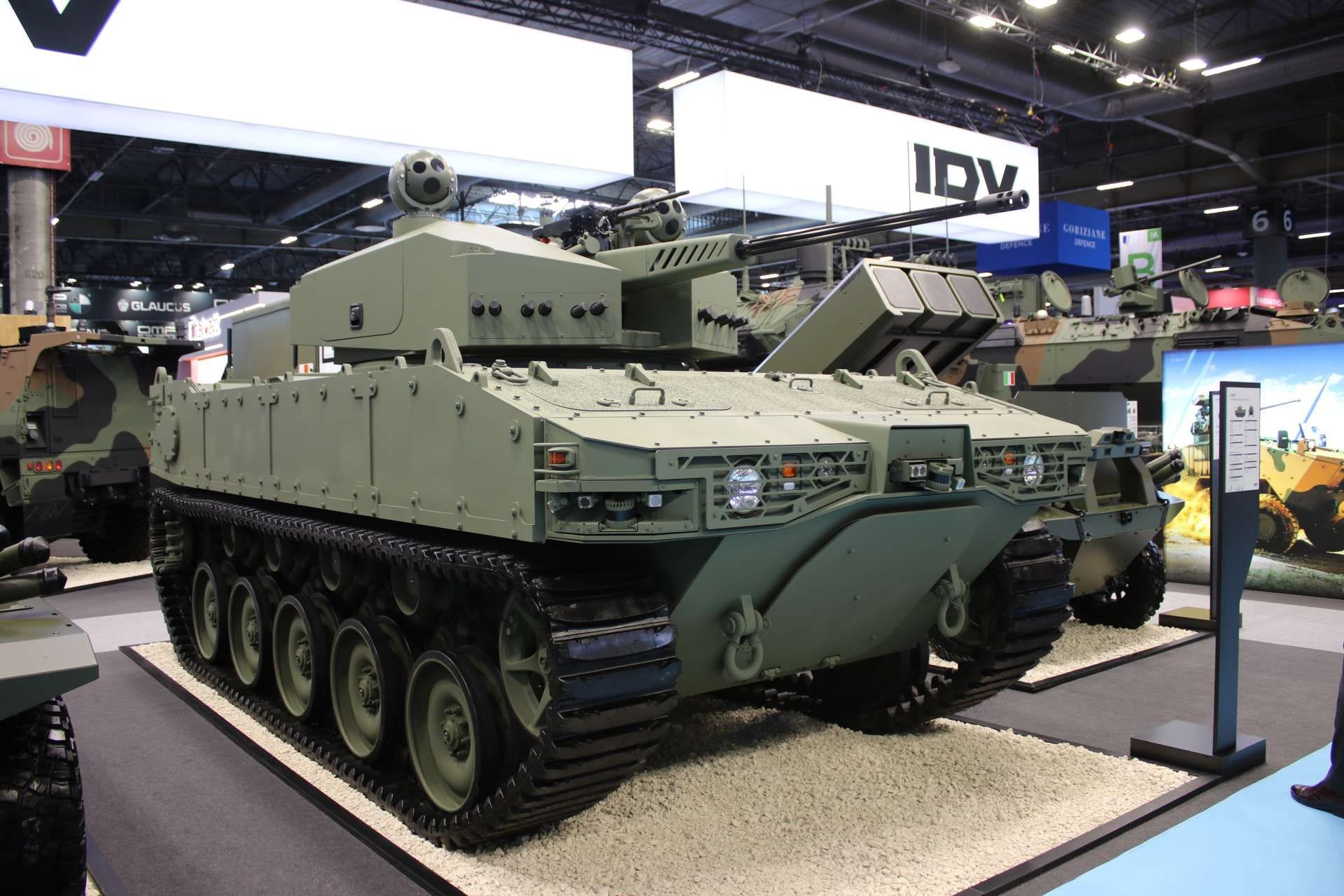
IDV’s new CL2X Hybrid Uncrewed Light Tank is an attempt at a 16-ton autonomous combat vehicle.
Is There an Unmanned Tank That Does Not Get Atomized?
Fine, take the crew out, make the tank itself “attritable”, and send it forward like an FPV you can afford to lose. Is anyone building that, and does it make sense?
The short answer is that the quadrant is empty, and it’s empty on purpose. Every serious program is either crewless with a light autocannon, or big-gun with the crew relocated into the hull. Nobody is fielding a no-crew, full-caliber gun tank that survives. The one program that ever specified one, the US Army’s Robotic Combat Vehicle-Heavy, never reached a prototype, and the whole Robotic Combat Vehicle effort was cancelled in 2025, weeks after Textron’s design won, then revived at a quarter of the price as something lighter. One of the few fully crewless heavy hulls anyone actually showed at Eurosatory, France’s REFURBOT, is a converted AMX-30 from which KNDS deliberately removed the 105mm gun and fitted a 25mm autocannon instead. When they de-crew a heavy hull, they take the tank gun off. They do it every time.
Blind without its sensors: A typical T-90 mission kill.
Why? The reasons stack. First, the operator behind a camera is not a crew. Decades of US Reaper research describe remote operation as working through blinders, which means that we’re looking at degraded situational awareness and near-total cognitive load just to drive, and a tank crew’s real advantage was always the four sets of eyes and the feel of the ground through the vehicle. We’re already seeing what happens when a vehicle loses that: The newer Russian tanks that lean on optics and camera feeds rather than the crew’s own eyes can be blinded outright. On the 1st of January 2024 near Avdiivka, an FPV sheared the electro-optical sensors off a T-90M without ever penetrating the hull, and the crew abandoned an intact but blind and deaf vehicle. Ukrainian pilots now steer deliberately for the sights, the sensors, and the antennas on the most modern tanks, and well over a hundred T-90Ms have been put out of action this way. An unmanned tank is nothing but sensors. It inherits that weakness and removes the human who might have worked around it.
Second, and worse, the link that gives the operator even the narrow sensory input is the first thing the enemy jams, and as the analyst Paul Scharre put it, “if you can jam communications links, you cut the human out of the system.” The fiber-optic trick that saved the FPV doesn’t transfer to a tracked vehicle that has to drive over its own thread through rubble. Full autonomy for a main gun is neither reliable enough, since machine target identification is brittle in exactly the cluttered scenes that matter, nor legally cleared, since US policy still requires meaningful human judgment over the use of force.
Third, and this is the one armor officers feel in their stomach, the close fight. Even a fully-crewed tank is half-blind in close terrain, which is why doctrine calls the accompanying infantry the tank’s eyes. Take Grozny in 1995, where a Russian brigade lost 20 of its 26 tanks to dismounted teams firing from basements and upper floors. A single man with a recoilless rifle, like a Carl Gustav, from an uncleared flank, ends a tank in a city street, and has been able to do so for fifty years. Now send an unmanned tank into that same street, with no crew eyes and no infantry of its own. It strips out both of the things that let armor survive close terrain, in exactly the place machine perception is worst. Look at where we are in terms of vehicle autonomy on streets with markers, and you’ll see that that’s not an answer, either.
The State of AI and Autonomy in Unmanned Ground Vehicles (UGV)

On March 12th, 2024, Ukraine’s Minister of Digital Transformation announced that Ukraine would shift to mass-production of robots in order to “minimize human involvement on the battlefield”. This strong market signal in “response to the numerical advantage of the enemy” led to a Cambrian Explosion in unmanned ground vehicles.
So, is the unmanned tank coming? Not the way the word “tank” wants it to. The unmanned ground vehicle that survives this war is light, cheap, attritable, and built to spare infantry, not a driverless version of a 60-ton gun platform. That’s why every program that removes the crew also removes the gun. And the tank’s other job, putting accurate high-explosive on a point target, is already being done by something else. A strike drone carrying a mortar round, drone-guided artillery, or a purpose-built warhead delivers the effect of a tank’s main gun or a light artillery piece, more precisely, for a fraction of the cost, and it does it from kilometers away instead of from direct-fire range.
Breach, Assault, and the Ground You Still Have to Hold
The tank was built to do three things: breach, assault, and help hold ground. The evidence of the last two years has pulled those three apart.
Breach and assault, in their massed-armor form, are broken, and the people who run armor say so. RUSI’s work on the 2023 Ukrainian offensive found that depending on small fleets of specialist enablers, the breaching vehicles, “is increasingly non-viable when the enemy can discern and engage specific targets within a formation,” because the engineering kit gets killed before it reaches the line. Lieutenant General Kevin Admiral, commanding III Armored Corps, put the American version of it on record: “armored units cannot rely on massing the combat capabilities of their platforms alone to achieve breakthroughs.” The Ukrainian attacks that made any progress against the Surovikin Line did so dismounted, led by sappers, not by massed armor.
The big question is whether unmanned systems will ever be able to hold ground, and for now it doesn’t look like they can, at least doctrinally. In the words of the Modern War Institute: Unmanned systems “can deny space, but they cannot seize territory, clear fortified urban centers, or consolidate a political victory.” From inside the Ukrainian effort, the reporting is just as plain: Soldiers are needed to clear and hold terrain. You attrit with a machine, you deny ground with a machine, but you hold it with a person.
And yet, the line is thinning. That NC13 position was a machine sitting on a contested crossing for a month and a half, and Ukrainian practitioners now describe such setups as dug-in denial points, remote observation and firing positions on the second and third lines, valued precisely because a machine doesn’t bleed. In the April capture, an unmanned system reportedly forced the defenders to surrender by threatening to detonate on their position, and prisoners were taken, something everyone had assumed was irreducibly human. Is that holding ground the way an infantry company holds it? No. It’s a serviced denial post that occasionally does something only a person was supposed to do. But the boundary moved, and it would be a mistake to wave that away.
So what are armies actually doing? Not abolishing the tank, for one. The driverless-tank vision (almost?) died with the Robotic Combat Vehicle in 2025. The convergent answer across the US, the UK, Germany, and Korea is to keep the tank, cut the fleet, demote it from leading the assault, harden it with organic counter-drone and electronic-warfare kit, and team it with unmanned systems. RAND’s wargaming came to a similar conclusion: Massed armor doctrine is broken, but the tank retains value as protected mobile firepower inside a combined-arms system that stays dispersed and masses only for the breakthrough. The British cut Challenger 3 to 148 vehicles, which serious analysts call inadequate for a single NATO armored division. The US Marine Corps divested every tank it had in 2020 and, as of late 2025, hasn’t bought one back. Everyone is hedging, and nobody is comfortable.
At the strategic level, the argument I keep coming back to is cost-imposition, and, bear with me here, Secretary Driscoll said it better than I will: “we are an incredibly wealthy nation, but even we cannot fire 4 million dollars of kinetic weaponry at 800-dollar drones for very long.” Affordable mass has made denial cheap. It has not made decision cheap. You can stop an attack with a cloud of cheap unmanned systems; you can’t yet take and hold the ground you’re denying with them. If both sides can deny and neither can hold, the transparent battlefield drifts toward a frozen, drone-saturated stalemate, and the side that reinvents a survivable way to break through, which was the tank’s original and entire reason for existing, gets the initiative back. Is that breakthrough machine still a tank? That’s the open question. There’s also a deterrence problem hiding here that nobody has solved. A forward-stationed armored brigade is visible, very much so, and it makes an adversary’s action allocate against it. I argued in Fisher’s Drone Doctrine that deterrence only becomes real when the other side’s planners have to account for you. It’s not yet clear that a distributed cloud of attritable unmanned systems deters, in the mind of a Russian or Chinese staff officer, the way a column of Leopards on the Suwałki Gap deters. That may be the tank’s last genuine job.
Recommendations
For Ministries of Defense:
Buy the function rather than the platform. The tank’s jobs (breach, direct fire, overwatch, even local denial) are unbundling onto cheaper unmanned systems faster than any new tank program will field. Fund the breaching UGV, the loitering munition, the counter-drone vehicle, and the electronic-warfare and networking layer that ties them, on the timelines you’d normally reserve for a flagship vehicle.
Treat the next tank as a node and write the requirement that way. If you’re buying M1E3, Leopard 2A8, or into MGCS, buy them as protected command and direct-fire platforms inside a manned-unmanned team, with organic counter-drone and the data backbone to run wingmen. A tank requirement optimized for a tank-versus-tank duel is buying the last war.
Solve the holding-ground problem deliberately, because it’s the one thing the machines can’t yet take. Your infantry is now, as it always has been, the irreplaceable arm. Protect it, mount it in things that can survive the approach, and accept that armor’s modern job is largely to keep that infantry alive long enough to occupy.
For Investors:
Fund the counter to the counter. The money is in the warhead-versus-protection spiral and the counter-drone layer: The seekers, the terminal-guidance modules, the airburst fire control, the affordable interceptor, the passive and active overhead protection. The cope cage gets beaten by the fence post; the fence post gets beaten by something; that cycle is your business.
Value the stack over the vehicle. As I’ve written before, the least visible parts of the kill-chain, the networking, the electronic warfare, the autonomy subsystems, the power and thermal management, are where the supply is short and the margin is (still) real. The driverless tank is a tangibility-bias magnet, so don’t fund it.
For Industry:
Build counter-drone as organic, not as an add-on. The market is shifting from the vehicle that carries a bolt-on jammer to the vehicle whose protection (active, passive, and its own interceptor drone) is designed in. Whoever makes that cheap, magazine-deep, and integrated wins a very large procurement, and the Eurosatory 2026 floor showed everyone now knows it.
Assume your advantage lasts months. In a COTS race, anything you field, the other side copies. Build for fast iteration and high-volume, low-cost production over exquisite performance, because the edge is, as always in COTS, in the cycle time.
Wrap-up: Can the tank keep up?
The main battle tank, in the shape we were all taught, was a single platform that carried breach, assault, shock, and direct fire inside one armored box, and went forward as decisive arm of battle. That platform is no more. Its jobs are being atomized onto things that are cheaper to lose, its protection is losing a printing race against the munitions, and the one mission the machines still can’t take, holding ground, is the one job a tank was never able to do alone anyway. The serious next-generation programs already concede to this argument: They protect the crew, not the vehicle, and they sell the tank as a node in a network.
I won’t pretend the pro-armor faction doesn’t have a case. Adapted armor survives more than the headlines suggest, the tank still draws fire away from infantry, and nobody has shown that you can take and hold ground without protected mobile firepower somewhere in the mix. The tank isn’t dead. But it’s looking for a new home among doctrinal options, and it’ll only find one by giving up what defined it, the idea that breach, assault, shock, and direct fire all ride forward inside a single armored box.
Which leaves the question this whole article revolves around. The munitions are getting better, the bombers are getting better, the autonomy gap is closing, and the tank is always going to be a large, hot, slow object that there’s only so much you can do to hide.
Can the tank keep up?
I’ll leave you with the three questions beneath this question which nobody can answer clearly, yet. If breach and assault have left the platform and holding ground is still human, what is the tank’s irreducible job, the thing neither a swarm nor a rifleman can do? The holding-ground function is thinning; where exactly does the machine stop, at occupying, at clearing a city, at accepting a surrender? And if both sides can deny but neither can hold, does whoever rebuilds a survivable breakthrough win the next war, or has the transparent battlefield foreclosed the breakthrough itself?
I have my suspicions on all three. But I’ve been laughed at before for less, so let’s watch the evidence come in.
If you enjoyed this article, I recommend reading my deep dive on the state of UGV autonomy (which is still accurate!) next:
The State of AI and Autonomy in Unmanned Ground Vehicles (UGV)
On March 12th, 2024, Ukraine’s Minister of Digital Transformation announced that Ukraine would shift to mass-production of robots in order to “minimize human involvement on the battlefield”. This strong market signal in “response to the numerical advantage of the enemy” led to a Cambrian Explosion in unmanned ground vehicles.
Disclaimer: This is neither financial not legal advice.
Thanks, Marc. I think you did an excellent job. It really is the bundling and unbundling phenomenon in action. The tank is being unbundled, or the role that the tank played is being unbundled, and other items are being bundled as part of a change in the stack.