
Where's the Answer to the Shahed?
Why We're Building the Wrong Stuff. Part One of The Missing Deterrent Series.

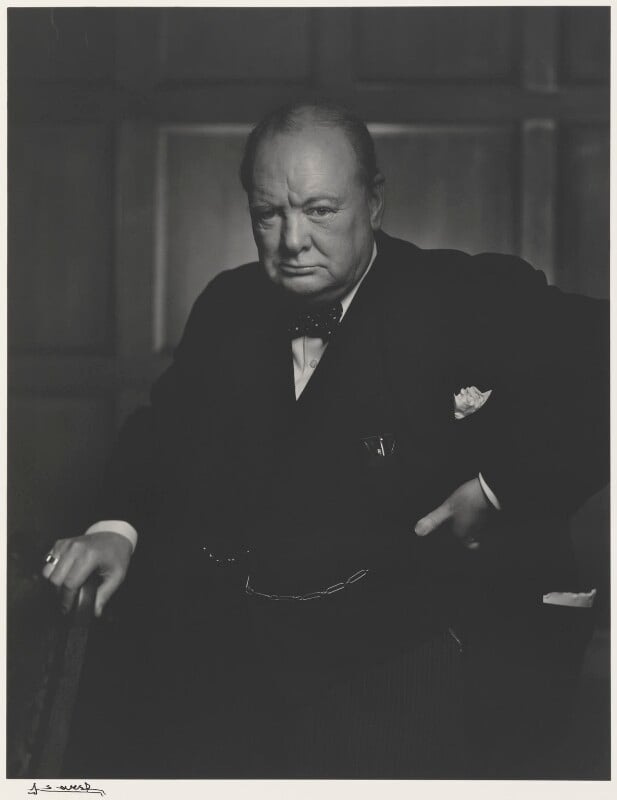
Guardian of an understanding of the meaning of deterrence which has been lost to peace-time dividend decades in most countries of the West: Sir Winston Leonard Spencer Churchill
Safety will be the sturdy child of terror, and survival the twin brother of annihilation.
—Winston Churchill, 1955
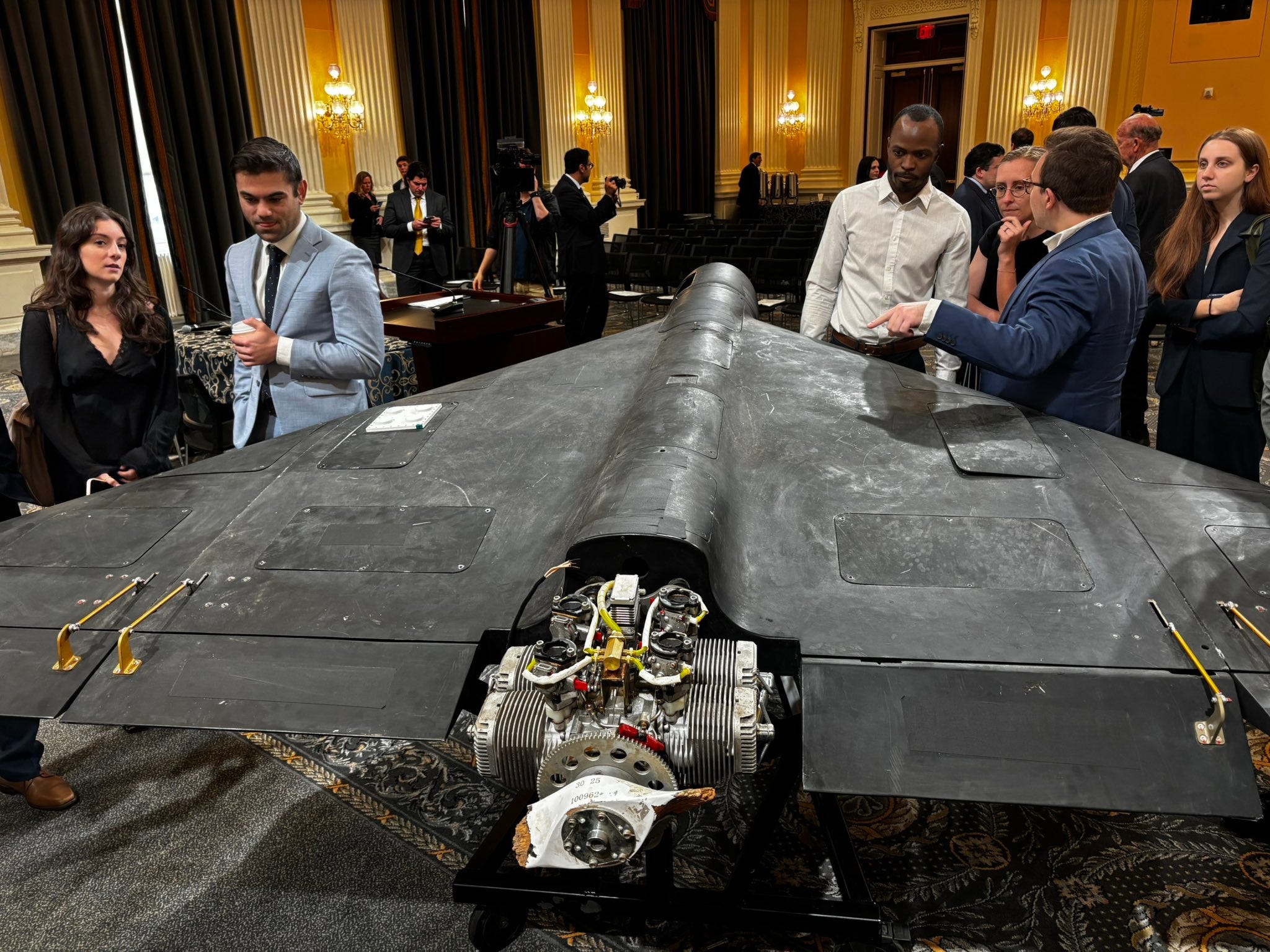
I like it. What is it? US lawmakers inspect the first-ever display of a Shahed 136 on Capitol Hill. Photo: Embassy of the Republic of Poland in Washington, D.C.
This one might hurt. a few folks, and I hope it’s in the right places. You’ve gotta give it to the Iranians...
What’s the meaning of deterrence? This might come as a shock to some of the folks reading this, but the thing the West needs most isn’t current interceptor drones, FPV quadcopters, or mothership drones. It’s neither the USVs, UUVs or UGVs on the market today. Sorry General Catalyst, sorry Peter Thiel, sorry Daniel Ek, not sorry. Have we entirely forgotten what deterrence actually means? Is the interpretation of most of the EU and US “neo-defense” industry that to deter, you wait until you’re attacked and then attempt to counter the attacker’s saturation salvos with if-not-already-then-soon-to-be-outpaced, out-gunned and out-priced interceptor drones sold in FOMO purchases to MoDs via paper-thin claims of autonomy that collapse like the wavefunction once examined in an actual experimental setting (let alone battlefield reality)? Is this the best thing our governments can incentivize companies to come up with? I’d like to invite especially all of the former tech folks who refuse to learn about defense strategy, economics or doctrine, these bone-dry topics full of jargon and history, and rely on flashy marketing as a core sales strategy, to let the text below sink in. Time to pull up a dictionary:

The Global Board of Advisors of the Council on Foreign Relations. Photo: Council on Foreign Relations
From the Council on Foreign Relations:
Deterrence simply means dissuading bad behavior with the threat of significant punishment.
It’s a practice that dates back millennia and extends beyond international relations. Ancient Romans, for example, carried out public executions to discourage would-be criminals.
Even today, deterrence underpins many countries’ justice systems. The threat of lengthy prison sentences—or even capital punishment—is intended to stop people from committing crimes.
In foreign policy, deterrence serves a similar purpose: maintaining peace by persuading enemies that any attack will be met with a significant response.
For deterrence to work, two conditions should be present: severity and credibility.
Severity entails threatening an opponent with retaliation that would outweigh any potential benefits they could hope to gain from attacking.
A severe response can take many forms, including harsh economic sanctions, diplomatic isolation, or military action. During the Cold War, nuclear weapons served as the ultimate deterrent for the United States and the Soviet Union. Both nations built enough bombs to annihilate the other.
Credibility means making an opponent believe that their further aggression will provoke retaliation. Countries can signal their seriousness by testing weapons, increasing their military presence in a contested region, conducting exercises to simulate real attacks, and publicly announcing new weapons technologies. *emphasis on announcing new weapons technologies by the author of the article
An important part of credibility is the willingness to use force. During the Cold War, both the United States and the Soviet Union established credibility by taking military action to support their foreign partners.
These actions demonstrated that they would be able and willing to follow through on their pledges to use force if an ally were attacked. The two superpowers also built special silos, planes, and submarines to ensure that if attacked with a nuclear weapon, they could still retaliate in kind. As a result, leaders on both sides knew a strike by either country would result in both being devastated.
This deterrence mechanism is an idea known as mutually assured destruction.
Do you see what I mean by what I wrote above? Looking at the market today, I worry that most folks in the industry don’t. Because we’re obviously the frog in the current of frog-boiling exercise, and, to me, it looks like industry is doing little to get us out of the pot. In this series, allow me to take you on a little ride and explain what I consider doctrinal collapse, what certain capabilities that are or aren’t being produced and procured have to do with that, and what can be done about it.
In this article, I’ll break down what our “new defense” industry, all of the prime contractors, and the established SMEs in NATO/Europe and the US have achieved so fat on our journey to make the West deter again. And yes, I’ll include Ukraine in this dissemination. No worries, this isn’t just some rant, this will contain the same level of depth in research and interviews and first-hand knowledge you’ve come accustomed to from TECH WARS Deep Dives so far.
I’ll do you one better: by the end of this series, I’ll describe a solution to the procurement crisis and consequential money maelstrom we are currently in, and outline a path out of it, including the missing solutions. In every part of the series leading up to its conclusion, I will also briefly touch upon these solutions already.
Before we get to that that, we’ll establish context, as usual, diving deep into what deterrence means in 2026 and beyond, and using experience gathered by and from Ukraine, as well as recent engagements like the attack of the United States on Venezuela as an example (the research and discussions about which have prompted me to take a moment longer in order to ensure this article holds up to the standard you’ve grown accustomed to).
After updating all of us on deterrence, I’ll have to call some of the solutions currently on offer out as being largely inappropriate and mostly useless for the deterrence of the main potential aggressors of the West. I’m aware that this might hurt a handful of people’s feelings about their proclaimed silver bullets and Wunderwaffen. Then again, if you feel addressed by this, then that may be a hint at your actual problem. Once we’ve properly scrutinized the non-solutions, I’ll try to make up for it by discussing the relatively easy actual solutions. As usual, we’ll go step by step, country by country, capability by capability.
But first, I want to come clean about something: I am neither an engineer, nor have I built a drone company, or served on the frontline or in the rear of the Russo-Ukrainian war. While I am involved in quite a few of these things, it’s rather with my mind and my mouth than with my hands. As such, I want to take a moment and pay my deepest respect to the folks who are risking their lives and/or their financial security in order to make a difference. I have zero doubt that without all those folks - all around the world - we would not only not stand a chance to achieve what I will describe at the end of this series, but - and this goes out to the Ukrainians in particular - we would also have been overrun already. So to all of those who make this new age of defense possible and who defend our lives, our freedom and our values: I thank you. What I will write about in this article is mainly directed at those who set the incentives for a system which fails to do what’s right, and those are not you. The same is true for most of the military planners and procurement officers which find themselves at the executive end of the system, and don’t get to set the highest-level market incentives. I know some of you are reading this, and I am grateful that you’re fighting the good fight. I have zero quarrels with you. And to the entrepreneurs: Throughout my work and my journeys, especially across the CEE region and Ukraine, I have seen approaches, technologies and solutions that could actually help, but have little chance to make it into actual serial procurement. This is because of a broken system, and it’s not your fault. So, once again, please don’t take any of this personal.
That’s it, disclaimers out of the way. Let’s jump into the article, starting with an update on deterrence.
Chapter 1: RIP Deterrence 🪦~11.000 BCE-2019 CE
To deter an action, the potential aggressor has to be certain that the cost will far outweigh any potential reward. In short: the enemy has to know, to truly believe, that if they hit you they lose more than they can accept to lose by any means. Ideally, you’re also capable of making it crystal-clear to them that they will be unable to land the hits they throw at you.
What is deterrence in 2026? Or, as some might ask: What’s deterrence worth in 2026? Many, including the author, have warned of the death of deterrence as a core element of defense doctrine due to the advent of hybrid warfare. How do you even begin to ensure retaliation in an age where 100% of the shooter-target disconnect has been accomplished? How do you declare an adversarial attack when the adversary can rely on plausible deniability? How do you even know that you’ve been attacked when the chance of your own rotten, broken infrastructure failing is greater on any average day than, say, a cyberattack by an adversary? How do you denounce an act of war when the declaration of war - as old as civilization - has come out of fashion, as has been evident in the most recent conflicts (see, I called them conflicts) between Israel, Iran, the US and Venezuela. How does one react to all of this from a doctrinal standpoint? How might we adapt our doctrine in order for us to not have to start from zero every time adversarial action against us takes place? Sounds like an uphill battle? It is.
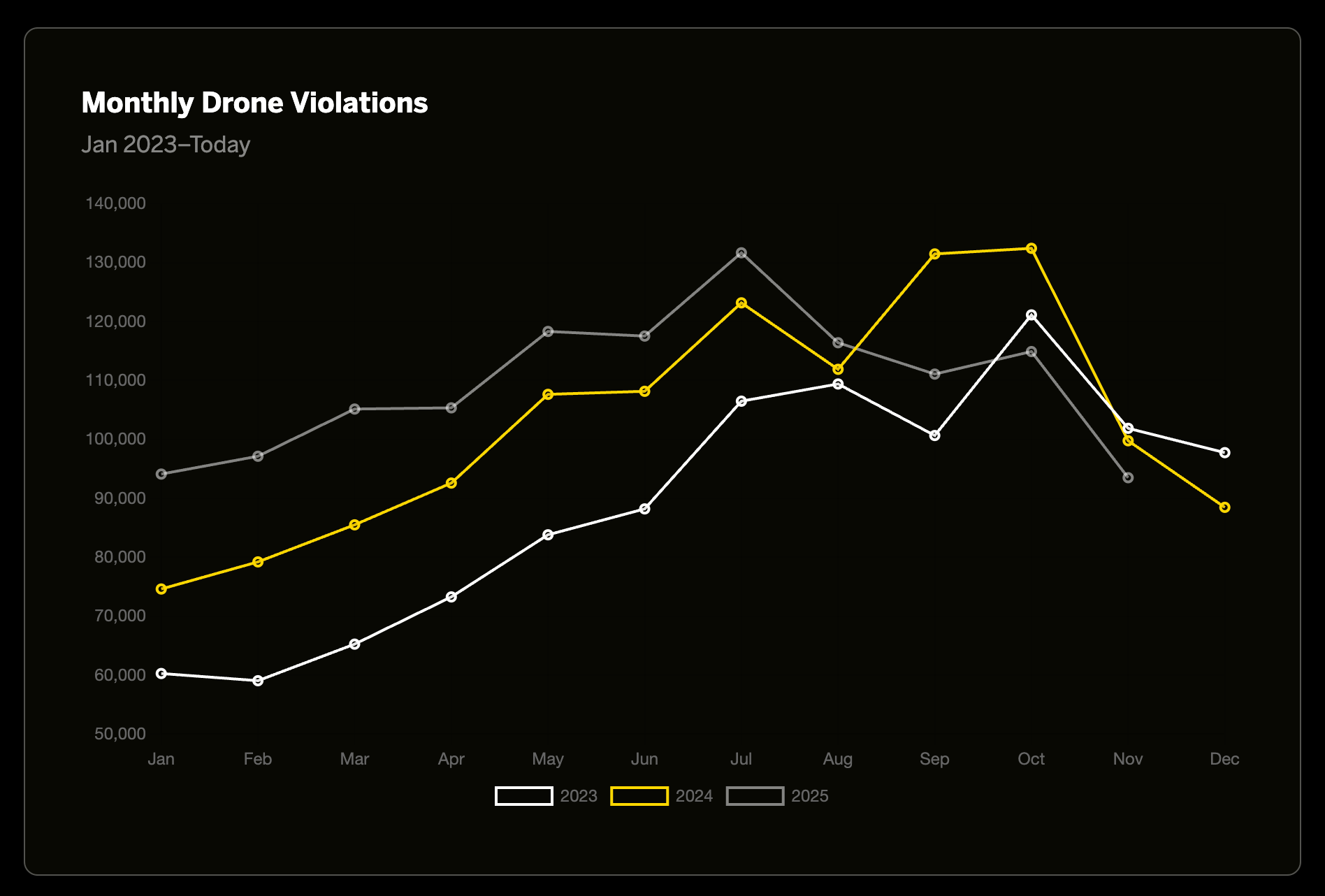
Not a mirage: monthly drone violations. Source: Dedrone
Worse: How do you react if unarmed reconnaissance drones which could just as well be armed constantly appear over your critical infrastructure and military installations? What about a border crossing of armed deep strike drones? What if they hit your civilians? What if the enemy adds a couple of stealth fighters armed with long-range cruise missiles and bombers to their border patrols? What if the stealth fighters violate your airspace without flight plans and with their transponders off?
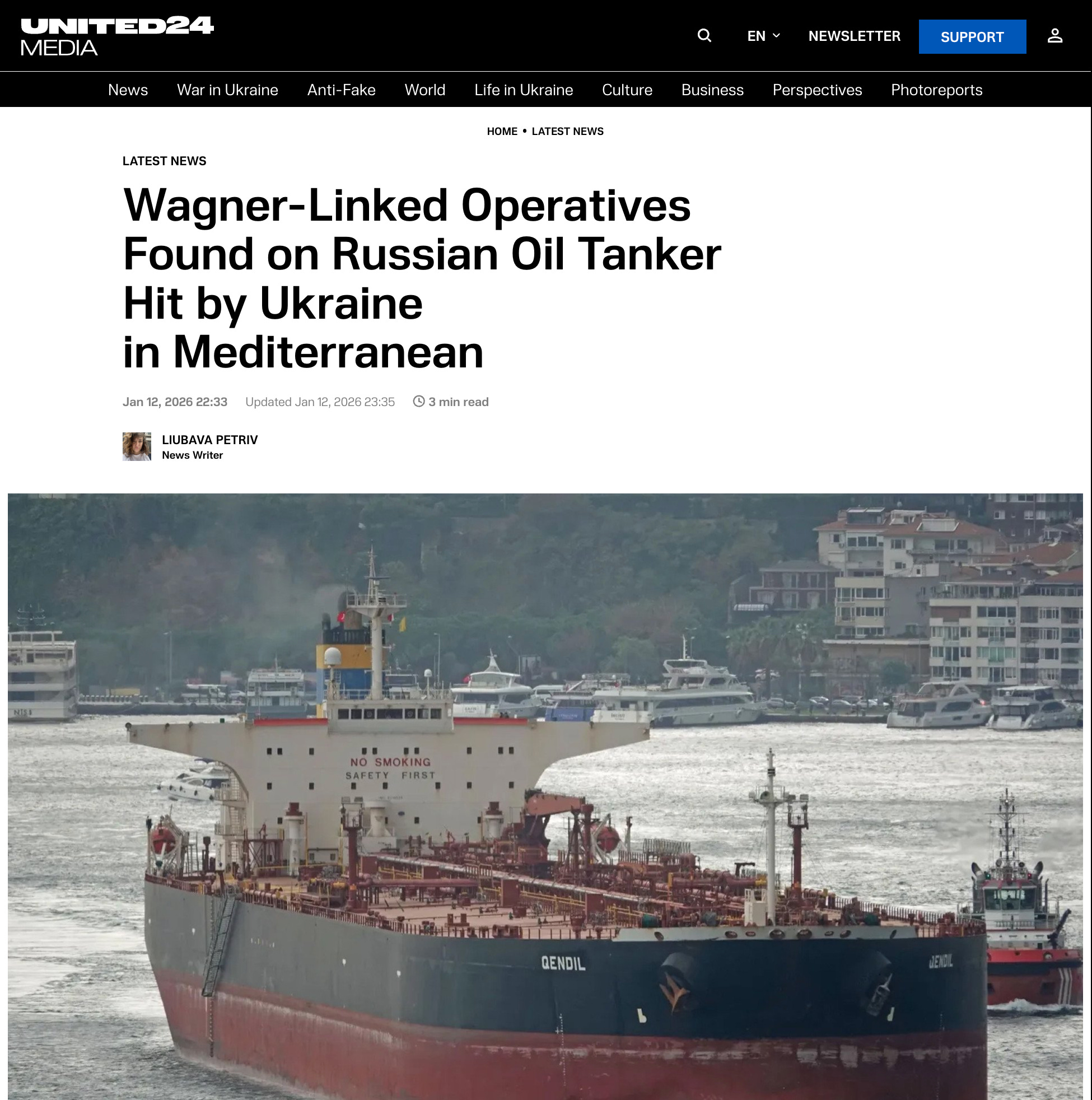
This is a thing now: Wagner paramilitaries onboard of shadow fleet tankers. Screenshot: United24
Even worse: How do you react when your enemy reacts to your attempts of dissuading them from circumventing sanctions and cutting cables by equipping their freighters and tankers with some of the world’s most frightening paramilitaries, and flanking them with corvettes, and escorting them with stealth fighters?
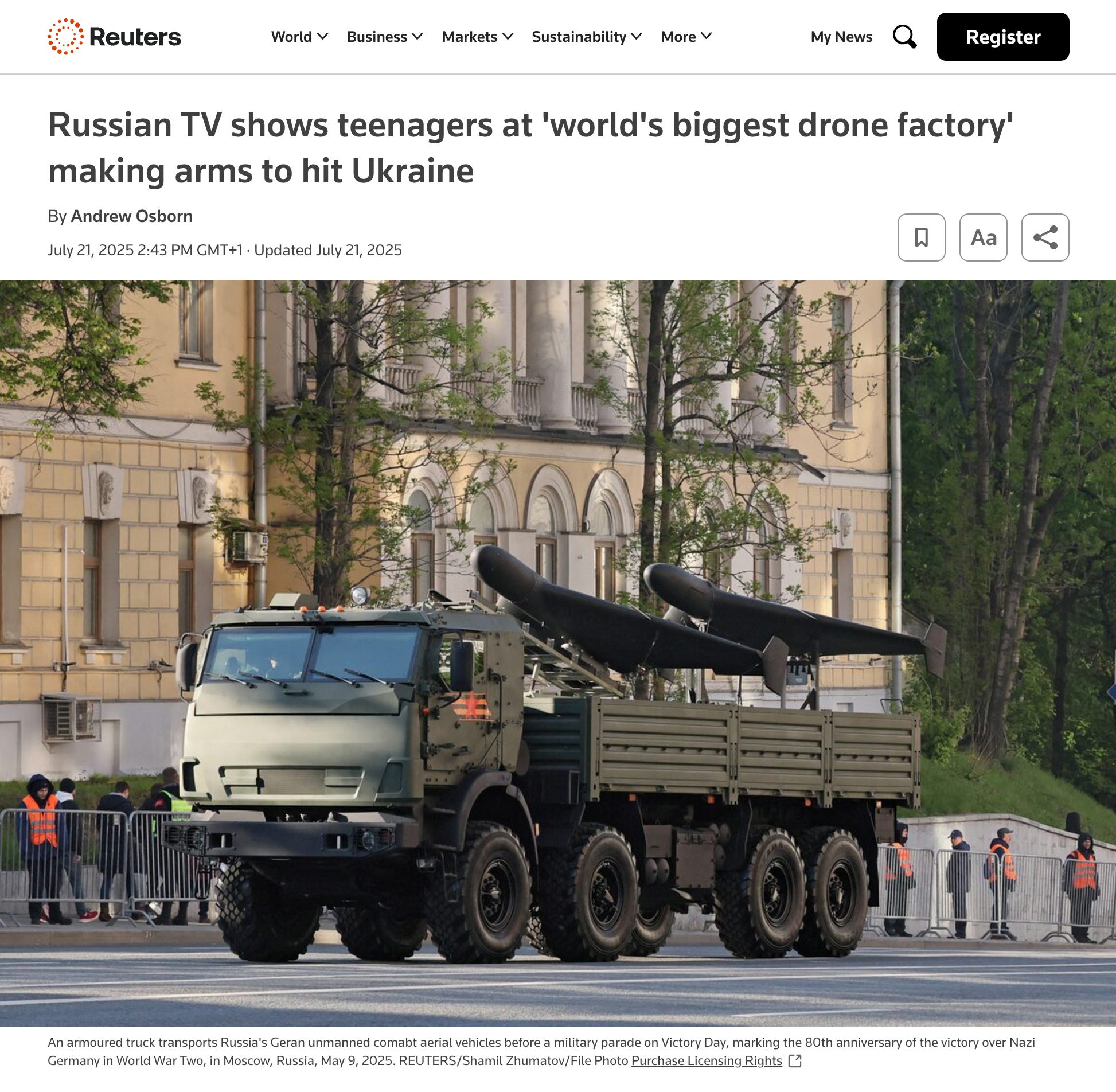
This is a thing (again): teenagers working at weapons factories. Screenshot: Reuters
Much worse (maybe): How do you ensure mutuality/adequate retaliation when you’ve slept throughout the entirety of the past decades of the precision strike military revolution, while one of your adversaries has ensured that their multiple-times (depending on the sticks compared) annual production advantage over your production numbers of deep strike munitions is going to be impossible for you to catch up with within the next decade or two - if you’re lucky, and they don’t decide to put the pedal to the metal even harder than they already are? What do you do if your enemy continues to reinvent entire capability categories, and drives the price per payload delivery over distances of above 1.000 km into the ground at an exponentially growing pace, while realistically flat-out denying you any proximity-, mid-range-, as well as any significant deep strike operations with the creativity of an evil school-boy. How about putting schoolchildren to work in their drone factories when dozens of layers of reinforced concrete don’t suffice to secure a good night’s sleep, because NATO would hardly strike that?
How does a nation successfully deter adversarial action in the age of all of the above?
What you see is what you get: ~10.000 words, 50 pages worth of deep industry insights. We don’t do superficial articles at TECH WARS.
What You Will Learn in this Article
All about the Death of Deterrence, what caused it, why it has been inevitable, what its symptoms and challenges are, and what this series will be about.
Why we’re currently Shopping for Defeat, which unmanned aerial systems are missing the mark, by how much, and what’s wrong.
How we can Resurrect Deterrence, what the requirements are for deterring again in and with the novel category of unmanned aerial systems, and what the exact specifications and requirements are that I would set as a bar if I were procuring for deep strike and interceptor solutions in 2026 and beyond.
Hello. Thank you for supporting my work. I provide technical knowledge and market intelligence about unmanned systems and AI for governments, OEMs and investors.
TECH WARS features comprehensive deep dives full of primary research, intelligence and experience I gather myself, from the offices of OEMs and startups to the forward edge of innovation.
They’re being read by MoDs, OEMs and SMEs, as well as their investors in PE, VC and banking. The TECH WARS Deep Dives take roughly a month to research and write (zero AI), are published bi-weekly, and are supported by my subscribers. A subscription also gives you access to hundreds of pages of already released TECH WARS Deep Dives. Go ahead and give it a try - you can cancel risk-free anytime!
