

Waterworld: How Drones Will Reshape Shipping (part one)
The threat posed by unmanned systems, and a glimpse of the future of unmanned systems against commercial shipping.

From the Red Sea, to the Black Sea, to the Baltics, to the Strait of Hormuz: unmanned systems are reshaping our expectations of safety on global waterways. For decades, global trade could rely on (relatively) safe passage through global oceans, from the vastness of to open oceans to the congested navigation challenges of chokepoints like the Strait of Hormuz or the Strait of Malacca. After:
Three years of attacks on shipping by the Houthis in the Gulf of Aden and the Red Sea,
One year of ‘kinetic sanctions’ against Russia, courtesy of Ukrainian Sea Babys and other unmanned surface vessels (USVs),
Six months since the US began seizing Venezuelan tankers on December 10th, 2025,
Two months of Iranian attacks on tankers in the Strait of Hormuz, and last but not least,
The US now getting into the tanker attack game, striking the smoke stacks of the Iranian-flagged Sea Star III and Sevda (see the video below),
It certainly looks a lot like the age of safe passage through the world’s seven seas is coming to an end.
What makes the increase in attacks on shipping particularly alarming is the fact that unmanned systems of the type which I discuss here on TECH WARS a lot are both increasingly becoming the weapon of choice, and, as I will argue throughout this article, are one of the reasons why we’re seeing these increases in the first place. In short: unmanned systems are taking the (attacker’s) risk out of maritime extortion, attack and robbery, and making the execution of such operations harder to predict, deny, and trace than ever before.
Toot: CENTCOM performing the old ‘banana in the smokestack’ trick on Iranian tanker Sevda by deploying 500-pound laser-guided bombs from a US Navy F/A-18 Super Hornet in the Strait of Hormuz on May 8th, 2026. Could this attack have been performed with drones for a fraction of the cost/risk, and at a much greater scale? Exactly. It’s not like bomber drones are a new thing.
What we’ll try to do in this article is achieve an understanding of both the unmanned threats and the potential countermeasures (a term I wouldn’t have thought to be using for civilian shipping protection, but that’s 2026 for you) the owners and operators of merchant ships and the countries that are trying to protect their supply chains throughout the world’s oceans might undertake.
What You Will Learn In This Article
Quick Aside: Legal Nightmare
Threats, Targeting, Terminal Guidance
Accessibility, Range and Scale
The Many Unmanned Threats
Mines
Cruise Missiles and Anti-Ship Ballistic Missiles (ASBMs)
Unmanned Aerial Vehicles (UAVs)
How to Hit a Ship With a Cheap UAV Over Large Distances
Starlink isn’t the Only Game in Town
Starlink on the Cheap?
How UAVs Might Be Adapted to Better Disrupt or Coerce Shipping
Unmanned Surface Vessels (USVs)
How USVs Might Be Used to Better Disrupt and Coerce Shipping
Unmanned Undersea Vehicles (UUVs)
How UUVs Might Be Used to Better Disrupt and Extort Shipping
Unmanned-unmanned Systems
Wrap-up: What We’ve Learned
Quick Aside: A Legal Nightmare
Let’s get this out of the way upfront: protection of commercial shipping against kinetic threats is a legal nightmare, and it only gets worse once you inadvertently exit international waters and enter the sovereign territory of nations. Because what might be tolerated in the middle of the Indian ocean quickly becomes a reason for a visit of the coastguard of Sri Lanka once you enter its sovereign waters.
This makes a lot of sense, given that the opposite scenario, where each of the about 60.000 ships that pass the southern tip of Sri Lanka every year take whichever measure they see fit to defend themselves against potential future long-range attacks with USVs, could end up creating more chaos than it helps avoid. This is even more of an issue given that a lot of the most recent incidents we’ve seen have been occurring in or near tight waterways, which are of course, understandably and without exception, heavily regulated. We will not discuss legal implications in this article.
HOWEVER
I’m sure we can agree on two fundamental facts: 1) global shipping is essential, no, existential enough for our economies and societies that it won’t go away, even if under increasing threat, and 2) the threat that unmanned systems pose in terms of potentially enabling dramatic expansion of attacks and extortion is real enough that solutions are needed and will be sought by shipping companies worldwide.
The former is proven fact - armed private security on merchant ships already is a multi-billion-dollar business that’s been growing for more than a decade, since (manned) piracy attacks such as those of the Somali pirates begun disrupting shipping around Africa. Some people don’t agree with me that the threat of an explosion in piracy and extortion because of unmanned systems is real. Let’s discuss it in more detail.
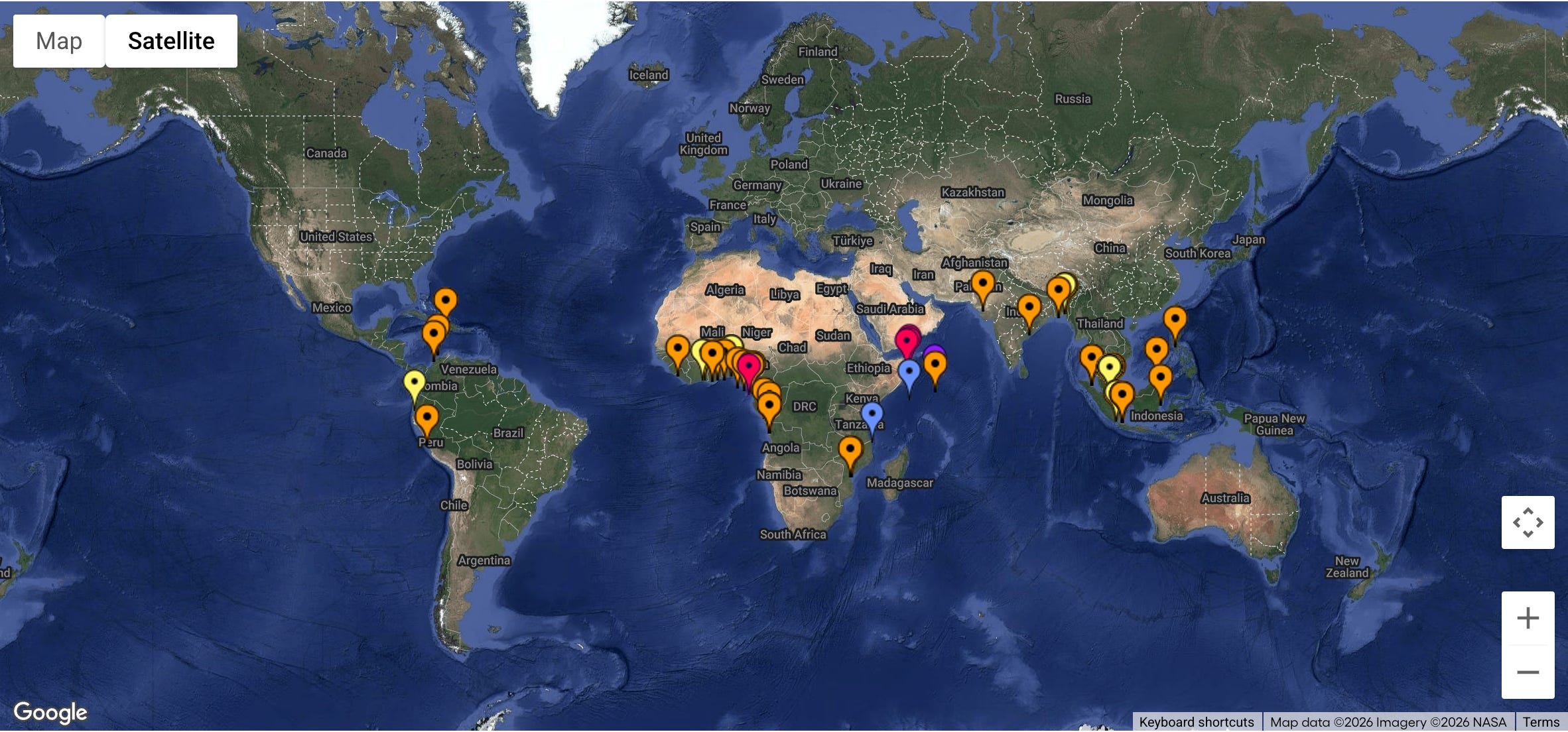
Connecting the dots: The 2025 IMB Piracy and Armed Robbery Map shows 138 major incidents. Source: ICC
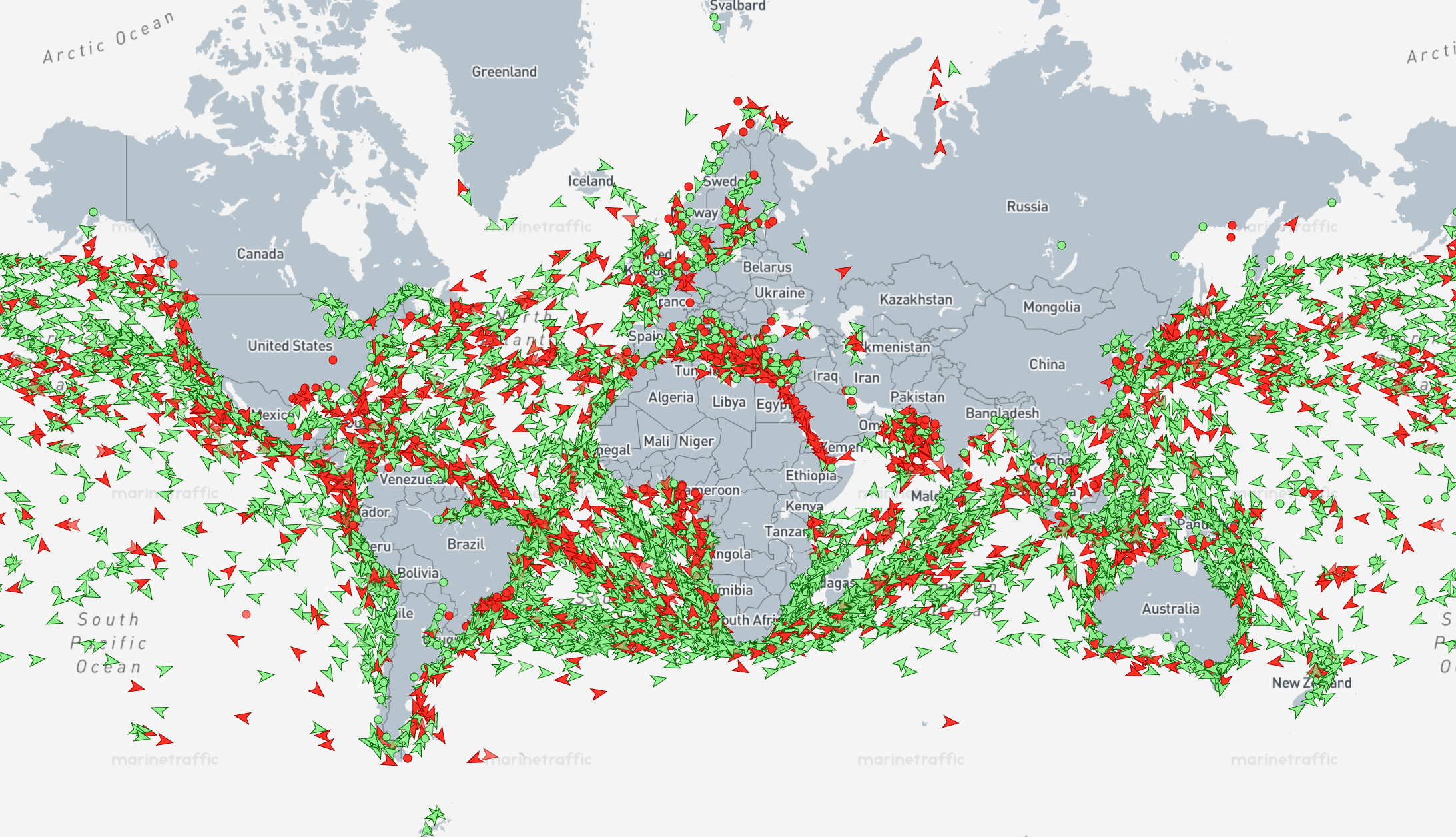
Arteries of matter: the Marinetraffic position of global merchant ships; screenshot taken on May 10th, 2026. Marinetraffic
Threats, Targeting, Terminal Guidance
While attacks on merchant ships and piracy are far from new (and a source for innovative and operational learnings, as I’ll elaborate further down in the article), attacks with unmanned systems are. It might be easy to brush those off as a symptom of regional conflicts and local terrorism, but I’d wager this would undersell the three core elements of the value proposition of naval operations with unmanned systems, namely:
Accessibility,
Range, and
Scale
Let’s go through those briefly in order to prime everybody about why I think that what we’re seeing in Iran and the Baltics is less of a side-effect of the respective war which is being fought in the area, but the rise of something more significant.
Accessibility, Range and Scale
The most important factor. Take a small speedboat, add actuators (or a steering wheel drive, or an autopilot from AliExpress), a Starlink Mini terminal, cameras, and a high-explosive (HE) payload, and you’ve built a one-way autonomous attack USV good enough to sink a containership, or put shipping in Bab-El-Mandab or the Dardanelles at risk, for as little as €10-15.000 (or less, depending on where you source the speedboat hull, autopilot and HE payload).
This is the reason why the Iranian mosquito fleet, for instance, or the comparably under-funded fleet of the Houthi rebels are so dangerous. As long as, e.g., Iran can produce a handful of (easily unmanned-convertible) vessels which can be sent into the Strait or the Indian ocean, the ensuing uncertainty will suffice for insurers to stop underwriting the (massive) risk this means for the half-a-billion-and-more-Euro-value of a large containership or a tanker. If insurers stop underwriting risk, most shipping seizes. Tankers and container vessels have simply become too large and thus too valuable for this not to happen.
The Many Unmanned Threats
A plethora of unmanned options are available to the modern pirate or shipping denial aficionado today, including a handful of lesser-known vehicles and vessels. Some of the vehicles we’ll be discussing might seem like they’re not suited for the task they’re being utilized for, at least at first glance. Some which might seem like they are, due to constant false claims in the press, are actually not suited for threatening shipping, due to the nature and design of certain merchant shipping vessels. Let’s start with some of the classics, before we move into more novel unmanned options, and learn which systems work for shipping lane denial but not for extortion or piracy, and the other way around, and which work for neither. Along the way, we’ll also discuss the (crucial) different methods for targeting and terminal guidance.
Mines
Sea mines, most of which look nothing like the ‘ball with spikes’ image most people have in their heads when thinking of mines (thanks, Hollywood), are actually quite versatile. The classic high-floating, bottom-moored spikey contact mines have mostly been replaced by mines employing a variety of mechanisms and methods for detection and engagement.
Modern bottom-moored influence mines, like the Iranian Maham-2 or Maham-7 for instance, use a multitude of sensors like microphones, as well as water pressure and magnetic sensors, to determine and engage a ship. Some bottom mines also contain counters, which allow them to be programmed to only detonate after x number of ships have passed overhead, aiding in the creation of uncertainty, which is one of the main raisons d’être of mines in the first place.
Smart mines can contain further sensors, friend-or-foe identification, and AI-driven decision-making. Some mines contain features for re-programmability (which is hard, because water is notoriously hard a medium for communication, and one of the tasks of mines is not to be detected). Rocket mines are moored to the bottom like their aforementioned bottom-moored siblings and can use similar sensors, but release a rocket upon detection, which can engage targets rapidly and at an angle, meaning that it does not need to be directly overhead, further increasing reach and decreasing security.
A similar kind of mine is the torpedo mine, which uses either a propeller (US CAPTOR, Anduril Copperhead) or a pump-jet (UK MK 48) to achieve a similar result. Some mines, like the aforementioned Maham-7, are also designed in a shape that evades detection by the sonars of minesweeping ships and USVs or unmanned undersea vessels (UUVs). In the case of Anduril’s Copperhead, the sensor and the effector are two separate units, and the sensors (Seabed Sentry) form a communications mesh, or grid, which can be utilized to coordinate attacks with Copperheads on overhead shipping or to create corridors for safe passage, for example.
Sea mines are a great way to create uncertainty at cost, as currently witnessed in the Strait of Hormuz, where an uncertain number of mines (none have been found and reported) are sufficient to create a major disruption. This has always been the key advantage of and use for mines: their cost-effect ratio is quite literally ridiculous, meaning that it is sufficient to be able to credibly proclaim the deployment of mines in order to achieve the desired effect, even if no actual mines have been deployed. As such, mines are excellent for paralyzing entire shipping lanes. They are less practical when the goal is to be highly selective, for instance letting all but Maersk’s merchant ships pass.
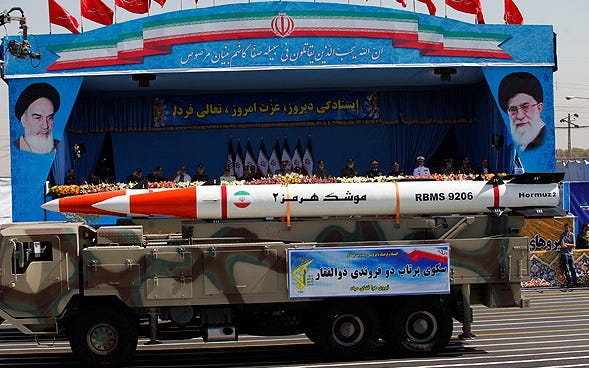
The Hormuz-2 ASBM swaps the passive radar seeker of the Hormuz-1 for an active one, in order to perform better terminal guidance for moving vessels (ships). Photo: Iran News Agency Fars
Cruise Missiles and Anti-Ship Ballistic Missiles (ASBMs)
Cruise missiles deliver effect at speed and accuracy. They are also significantly more expensive compared to drones. This might be one of the reasons why Iran’s weapon of choice for attacking tankers and the like in the Strait seem to be unmanned systems like unmanned surface vessels and aerial vehicles (USVs and UAVs, respectively).
The Paveh & Ya-Ali, Iran’s affordable, mass-producible, turbojet-powered cruise missiles, are estimated between €130.000 and €300.000. What held true in 1980 holds true in 2026, and, despite startup publications calling the advent of the cheap missile, will mostly hold true throughout the Drone Age: There are simply too many valuable parts and too much highly skilled labor that go into making a cruise missile, or any missile for that matter, let alone operating it.
It’s no wonder, then, that Iran has turned to the ‘poor man’s cruise missile’, the Shahed drone, and to USVs, for striking merchant ships, and has reserved its cruise missiles to annoy US warship commanders. And that’s despite Iran actually having ample talent and supply chain resources to produce cruise and ballistic missiles. This is not something which your average non-governmental actor, pirate or rebel group will be able to whip up anytime soon. At a time when even the German government is actively looking for short-to-medium-term solutions to fill the missile gap (read: one-way attack/OWA UAVs), the use of missiles to disrupt shipping remains the luxury of the few nations who can produce enough of them, so China, Iran, North Korea and, yes, the US (e.g., the Precision Strike Missile, or PrSm, if no ‘Quicksink’ JDAM guided bombs are at hand).
ASBMs can be even cheaper, with Iran’s aptly named Hormuz ASBM low-end estimate sitting at €85.000, despite the ability to hit moving targets, but that’s still a far cry from the cost/accessibility, range and potential scale of drones. However, it should be noted at this point that ASBMs are virtually undefendable against by commercial shipping, requiring Patriot PAC-3 or similar (THAAD, Aegis SM-3/SM-6) missiles, which are of course unavailable on, say, the MSC China, and this will likely stay this way indefinitely. Electronic Warfare (EW) systems are used to disrupt radar-based guidance systems, but that’s not something you want to rely on solely, and high-energy lasers like the Iron Beam are still very early in their development and come with other issues, but I’ll save those for the countermeasures follow-up to this article.
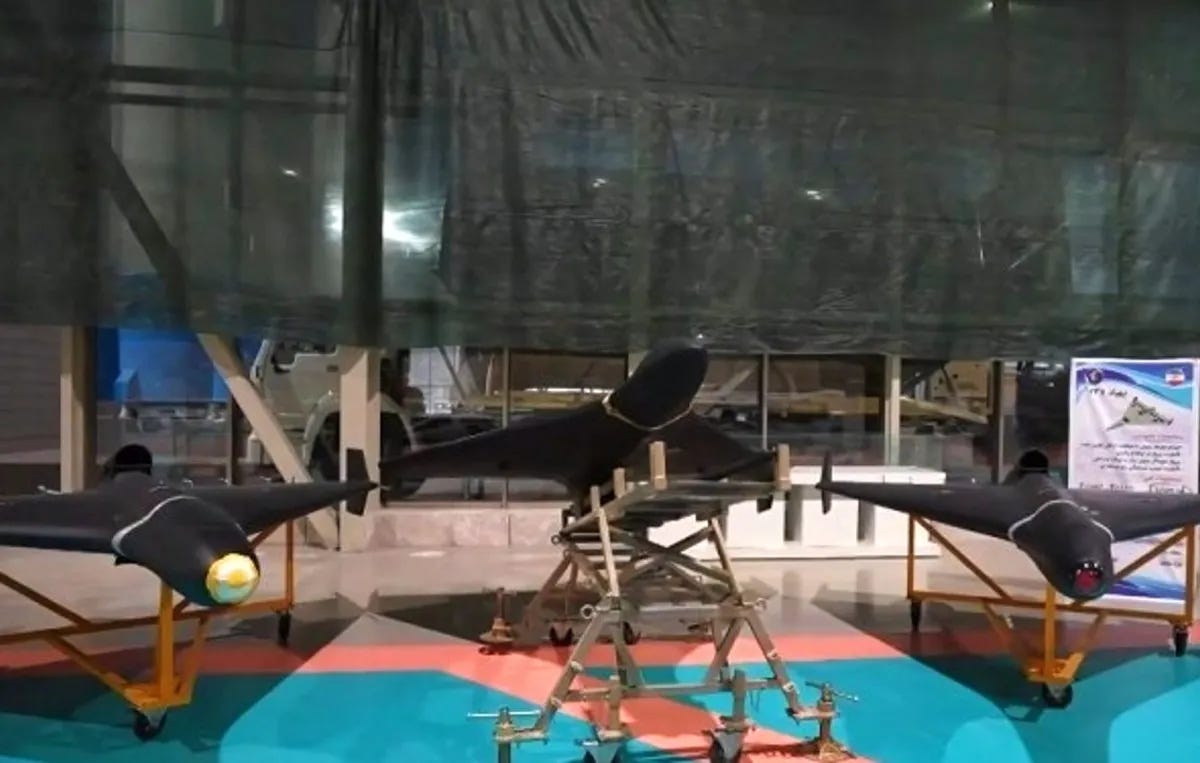
A series of Shahed-238, likely early/decoy versions, outfitted with different kind of warheads, including a radar-seeking and a heat-seeking version, at an Iranian government exhibition.
Unmanned Aerial Vehicles (UAVs)
UAVs, or UAS (systems in the latter case), have come a long way since they first started being used at a strategic level in the Second Nagorno-Karabakh War in 2020, and their variety today is unmatched by any other systems category. You’d be forgiven to think that the Shahed drone was designed to be an anti-civilian ‘shock’ loitering munition, given Russia’s cruel utilization as a mass-warcrime-effect. In its original designation, the Shahed was indeed designed as an anti-radar loitering system - curiously noted by Ukrainian press recently as a novel development (which it is for operational use in Ukraine/the Russian Shahed-derivative Geran, just not for the Shahed system itself, which goes back to the 1970s).
While the Shahed-131 (comparable US drone: the LUCAS), which has been in use in Iran in limited numbers) and its larger sibling, the 136, are incapable of achieving effects anywhere near those of even the lowest-payload, lowest-speed anti-ship cruise missiles (ASCMs; also wrapped into the anti-ship missile category; AShm or ASM, respectively), their Tolou-10 turbofan jet-engine-equipped siblings, like the Shahed-238, 359 loitering missile, and the Arash-2, are capable of striking targets with speeds 700 km/h and more in dive attacks, utilizing the old adage that if your payload is insufficient for the desired effect, try slinging it at your target harder. In the case of the Arash-2, its full nominal payload capacity (for which we still need to see evidence) even renders it potentially capable of delivering a 250 kg warhead at 700+ km/h. That’s ample bang for considerably lower buck, given the cost-sensitive engineering of the A-2).
Iran is by far the only serious player in this game, of course. The US Navy has the Switchblade 600 (it even tested it for operation on USVs), which is suitable for attacks even on the reinforced hulls of tankers when equipped with its shaped-charge high-explosive anti-tank (HEAT) warhead (which is capable of penetrating an estimated 600-800 mm of rolled homogeneous armor (RHA) behind Explosive Reactive Armor (ERA) in the case of a tank), Israel sports the equivalent Hero-120 (sold by Germany’s Rheinmetall, among others), and China the ShenZen SkyWing. Think maritime attack UAVs are a resource exclusive to legitimate governments or the Western hemisphere? Think again: Rebels in Myanmar have used UAVs to strike riverine ships, to point to just one example.
An important point that must be made at this point is that, as is the case in Ukraine, the use of bomber UAVs, where feasible, is often the more scalable and economic option. but let’s discuss the How for a moment.
How to Hit a Ship With a Cheap UAV Over Large Distances
Shahed drones normally fly on pre-programmed paths, which makes them less suitable for attacks on shipping. That’s not entirely true, though, as merchant ships travel on highly predictable paths, and, in narrow waterways like the Strait of Hormuz or Bab-El-Mandeb, travel time to target can be measured in minutes, even at the comparably snail-paced 185 km/h cruise speed of a Shahed-136 drone. The thing is, merchant ships are slow. Incredibly slow. A large oil tanker or container vessel travel around 300-400 meters (!) per minute. Yes, it is possible to predict with a high degree of certainty/success where the ship will be ten minutes from any given point in time. No, this is not how we were taught precision warfare works in 2026. This sounds more like pre-coincidence-rangefinder targeting of naval gunners in the early 1900s.

Not a tanker, but you catch my drift: IR signatures of naval vessels are like detailed strike maps. Image: WR Davis Engineering
Of course, with a radar seeker head like the aforementioned one on the Shahed (or anti-radar version of the Russian mid-range Lancet drone), which Iran continues to produce not only for the Shahed but also for its many parts-shared, platform-engineered siblings like the 358, there’s no need to break out the ruler in order to ensure that the drone/message doesn’t miss its goal.
A simple, cheap, and similarly widely available alternative to the radar seeker: infra-red (IR) seekers. Those are perfectly suitable for shipping attacks due to the heat signature of large shipping vessels (especially around the exhausts/smoke stacks, which, if sufficiently damaged, render the ship unable to continue its journey), and have apparently already been used to strike ships in the Strait, according to RUMINT.
If a hit is meant to scare rather than to sink is the goal, targeting can be achieved by more mundane methods. A civilian fishing vessel nearby, for instance, can, especially in narrow straits like that of Hormuz, provide relatively accurate GNSS positioning data, speed and bearing for a nearby tanker or container ship. Or, even though use of it has gone a bit out of fashion in the Strait recently, an attacker could use the ship’s automatic identification system (AIS) position (AIS is accurate to within below 2 meters) in order to hit it. Or to almost hit it. Because, let’s not forget, in many cases, the money (coercive value, battle victory, etc.) is in the shock, not necessarily in the successful strike.
Next Section: Starlink Isn’t the Only Game in Town
Hi! Glad You’re Here
If you’re subscribed to TECH WARS, you are likely one of the few defense professionals who demand all of the dots to be connected, from technologies to training, to tactics, operations, strategies, logistics, defense economics, force structure and posture. I can imagine that you’re the kind of person who often asks themselves questions like “Could this tactical-technological iteration accelerate into a strategic effect?” If this is you, then thank you, I’m glad that you’re here. You are part of a very small, open-minded group who aren’t scared to question defense paradigms and prevailing currents. Thank you for subscribing to my research, analyses, and ramblings. If you have a colleague who thinks like you, or who would benefit from some perspective, would you mind letting them know about TECH WARS? I know you don’t need it, but I’ll give you free months for it. Thanks for reading TECH WARS and thanks for spreading the word!
The 15-page report you’re about to read.