
Long-range Terrorism
Why the most alarming development coming out of Iran is about the Ukrainian manpower shortage, and what changed our mind on a crucial strategic matter.

“However, any such cooperation aimed at protecting our partners can only proceed without diminishing our own defense capabilities here in Ukraine.”
Ukrainian President Volodymyr Zelensky in his evening address on the 3rd of March, 2026; longer version further down in the article.
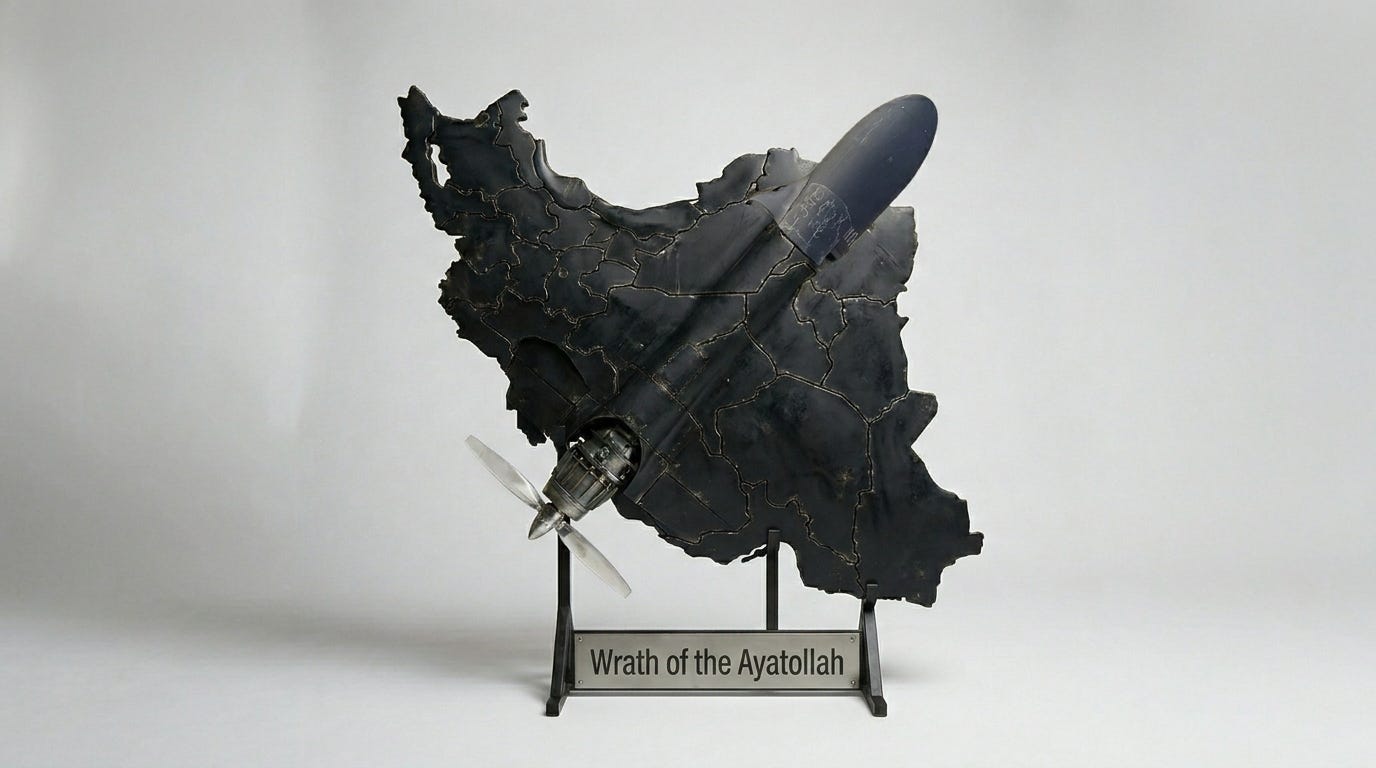
If you’re waking up these days, asking yourself how it can be 2026, 2014 and 1991 at the same time, all while the geopolitical cards have are being reshuffled into a catch-22, don’t worry, you’re not alone.
Let us be candid, the strategic and geopolitical situation is very messy, and so is the defense economic one, as are the military planning and procurement pictures. “We” are not “winning”. What we’re witnessing are short-term gains which will be very costly as the war inevitable drags on, which it will (with the Trump administration already stating that it might take a month, or “much longer”, which is also the name of a new measure of time which military planners get to stay at work), garnished with sprinkles of unpredictability around less-important topics like nuclear proliferation (the stockpile needs to go somewhere in case of a ground mission) and other, potentially way more dangerous technologies like drones in the mid-to-long-term (challenge us on that notion in the comments). And now, the EU finds itself in a strategic pinch it doesn’t even realize, yet. Great.
What the US’ and Israel’s War on Iran (or special military operation, if you want to sound trendy, since wars apparently don’t exist anymore) is starting to look like is what one might call ‘poking a technological wasp’s nest, just with infinite wasps’.
In These Field Notes
The Dirt-cheap Wrath of the Ayatollah
A Tidal Change in Warfare
Long-range Terrorism
The Iran-Ukraine War
Not Enough for Everyone
A Catch-22?
How to Turn the EU Into a Shahed No-fly Zone, the Hard (and currently only) Way
The Ship Is Sailing for the EU

The Dirt-cheap Wrath of the Ayatollah
Asymmetry has gone long-range, and there’s no turning back. Our leaders don’t yet fully understand what this actually means for defense strategy, procurement, and industry building (we’ll prove that further down in this article, and lay out a blueprint for how to change that). There are ways to defend against deep strike drones, but NATO nations have regrettably missed the train while waiting for a more sophisticated innovation to appear out of thin (very thin) air, as we’ll explain shortly. But first, a word from our sponsor on smoking out wasp’s nests, and the tendency of wasps to sting their attackers.
The most painful aspect about asymmetric warfare is not that asymmetry can go both ways, but that history teaches us that every single time, it goes the other way in a novel, unpredictable way, or at least in a way which the stronger force isn’t sufficiently prepared for. This happened to Russia in Ukraine, and it is happening to the United States and Israel in Iran and the Middle East as we speak. But it gets worse: We might have arrived at a moment in time (which we call historic) when the spillover effects of asymmetric technologies and techniques are becoming problematic for an entire host of NATO and NATO-allied nations, and while the effects are already quite worrying, we’re certain that this is just the beginning of the j-curve.
Air defense from below in Vietnam, victim-operated IEDs in Iraq, mountain ambushes in Afghanistan: The US and their allies burn their fingers every time they start an asymmetric war.
If you can see a Reaper with bare eyes, you should call your air defense vendor. Video: milblog Twitter
The US and Israel are far superior to Iran’s forces, granted. This is evident in Reaper drones firing relatively short-range AGM-114 Hellfires at Iranian targets. That’s not something you can do if you haven’t achieved a solid degree of air superiority.
The nature of asymmetric warfare - a weaker opponent using guerrilla tactics and other means of expedient defense; something that is descriptive of the early days of the Russo-Ukrainan war as well, though it played out in its own fashion - has been changed forever by the Shahed drone. What we are witnessing is basically a second revolution within the drone warfare revolution with far greater implications than an aftershock following an earthquake. Let us explain:
A Tidal Change in Warfare
Guerrilla warfare - often called terrorism by the opposing side - had always been limited in range, either due to arsenal depth, or due to cost-prohibitiveness, or technological immaturity, or a mix of all three. Yet now we’re seeing the most powerful nation on Earth being struck, its allies being struck, painfully, in places that should be out of bounds for the attacked nation. If we stick with the propagandist term of terrorism, then we suggest that we call its deep strike version:
Long-range Terrorism
Iraq, too, managed to strike US and allied targets during operation Desert Storm. It had to use Soviet Scud missiles for that, though. While relatively cheap, they cost a million a pop in 1992 money (about $2,3m in today’s money; Patriots were $700k btw), their number and price was far from the ubiquity of the Shahed. Strikes on Israel were made possible by reducing payload (Al-Hussein; the indigenous adaptation of the Scud-B). We’re arguing that the situation is far different now than it was then, and that this is a real problem for all of us, including the United States.
As has been reported everywhere, while PAC-3 Patriots cost millions of dollars today, similar effects to those in 1991 are now achieved by a significantly degraded nation, for peanuts (albeit only on less-hardened or explosive targets). Internal production cost of a Shahed 136 could be below $20k by now, given the economies of scale and Iran’s experience in manufacturing. At $200k per strike - heck, even at $500k, given its suitability for low-skilled mass-production, the deep strike drone has emerged as one of the most revolutionary means of attack from the Russo-Ukrainian war.
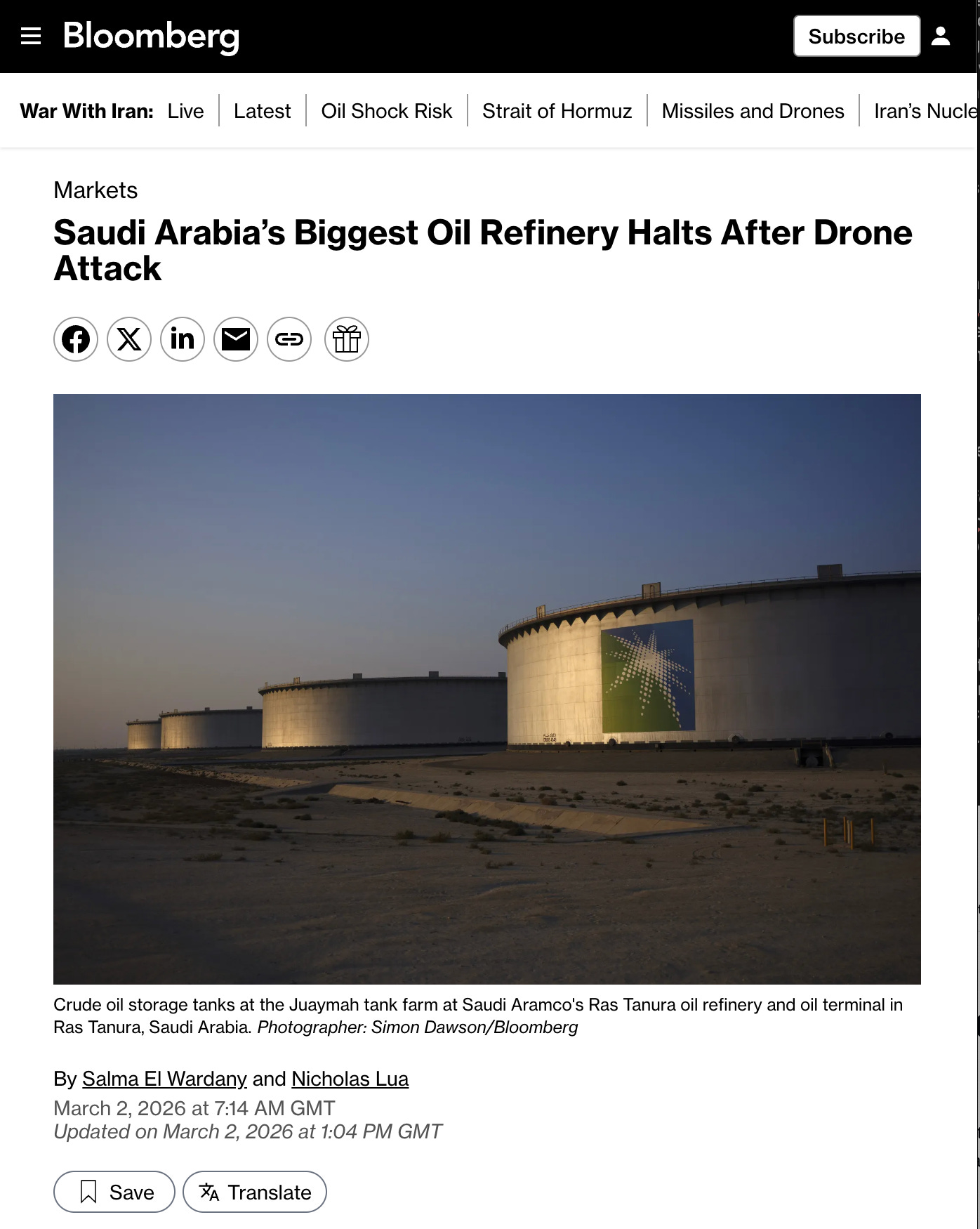
How could this happen? Exactly.
Not only that, these systems can achieve the same effects on, say, a fuel plant, at close to four times the distance of short-to-mid-range cruise missiles. Or avoid air defenses before striking targets by flying around them. Four times the distance at a strike cost of a fifth. Do you see the writings on the wall?
What worries us most about the Iran war is that nothing is being done (can be done? Let’s not be that gloomy) against the proliferation of Shahed-like deep strike drone technology. This fact, in large part owed to the relatively low-tech, commercially sourced nature of deep strike drones, means that small African nations can now in theory obtain the capability of attacking European soil without much need for foreign support, or many options for interference or interdiction.
That’s a very messy new strategic environment, which will have strategists, planners, and general staff scratching their heads for years to come; all while North Korea, to name just one example, already produces a multitude of Shaheds far superior to the US’s LUCAS drone production, and every nation which is in the Shahed business in 2026 should safely be expected to learn from recent Russian iterations and upgrades, as well as performing its own domestic iterations. Let’s examine the defense economic and technological impacts for all parties involved (and those not involved) more closely. What does each of them stand to gain, what might they lose?
The Iran-Ukraine War
You’re Missing Out!
Join some of the world’s most senior top executives in MoDs, industry and investment, including some of those behind the programs and products you are reading about in our publication. Pierce through headlines and inflated innovation claims like Edward Scissorhands through wet paper bags. Tradeoff analysis: What’s the bigger risk: a couple bucks less or missing out on insights which our readers describe as truly unique? Get subscribed to TECH WARS now and gain access to hundreds of pages of up-to-date tech, strategy, and procurement insights you won’t find anywhere else - you’ll be in good company.